Numbering
№001 / ∞
Progressive across the whole collection, from the first piece onwards. The number stays the same forever.
 Raphia & Résineby SpazioAlieno.Art
Raphia & Résine by SpazioAlieno.Art
from the Latin oculi, “eyes”
Sculptures and lamps in Madagascan raffia and resin
Nosy Be, Madagascar · Milan, Italy · Catalogue 2026–2027
No physical trace remained. What remained were the eyes of those who looked.
The Story
On 16 August 1954, shortly after five in the afternoon, thousands of people saw a luminous green object, shaped like a rugby ball, pass over Antananarivo — then Tananarive. It flew low, less than a hundred metres above the rooftops, in total silence. As it passed, the lights of the neighbourhoods beneath it went out, and animals fled in fear.
The French Air Command on the island entrusted the inquiry to the director of the astronomical observatory, the Jesuit Father Coze. To this day, the case remains unexplained.
No physical trace remained. What remained were the eyes of those who looked.
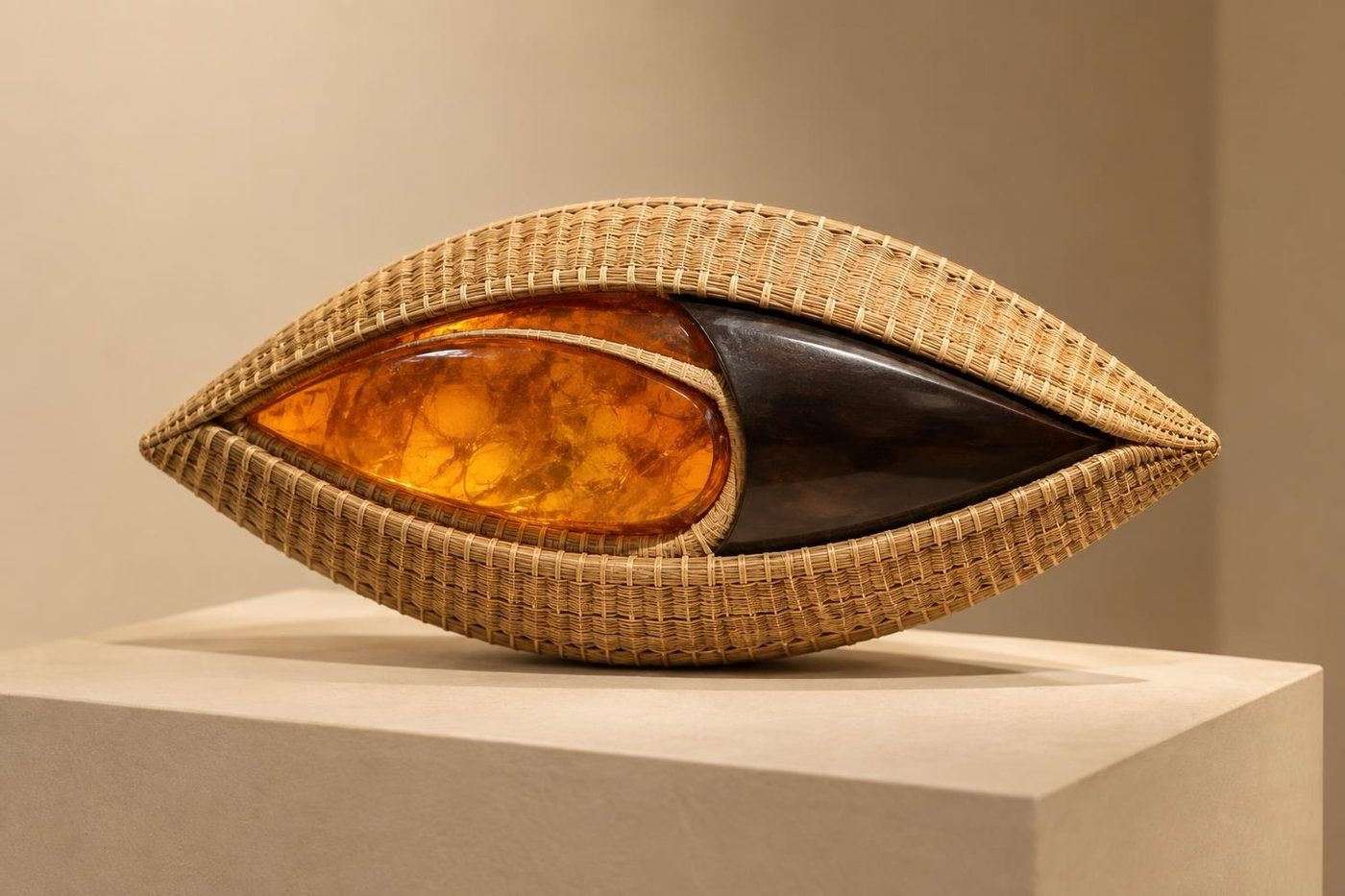
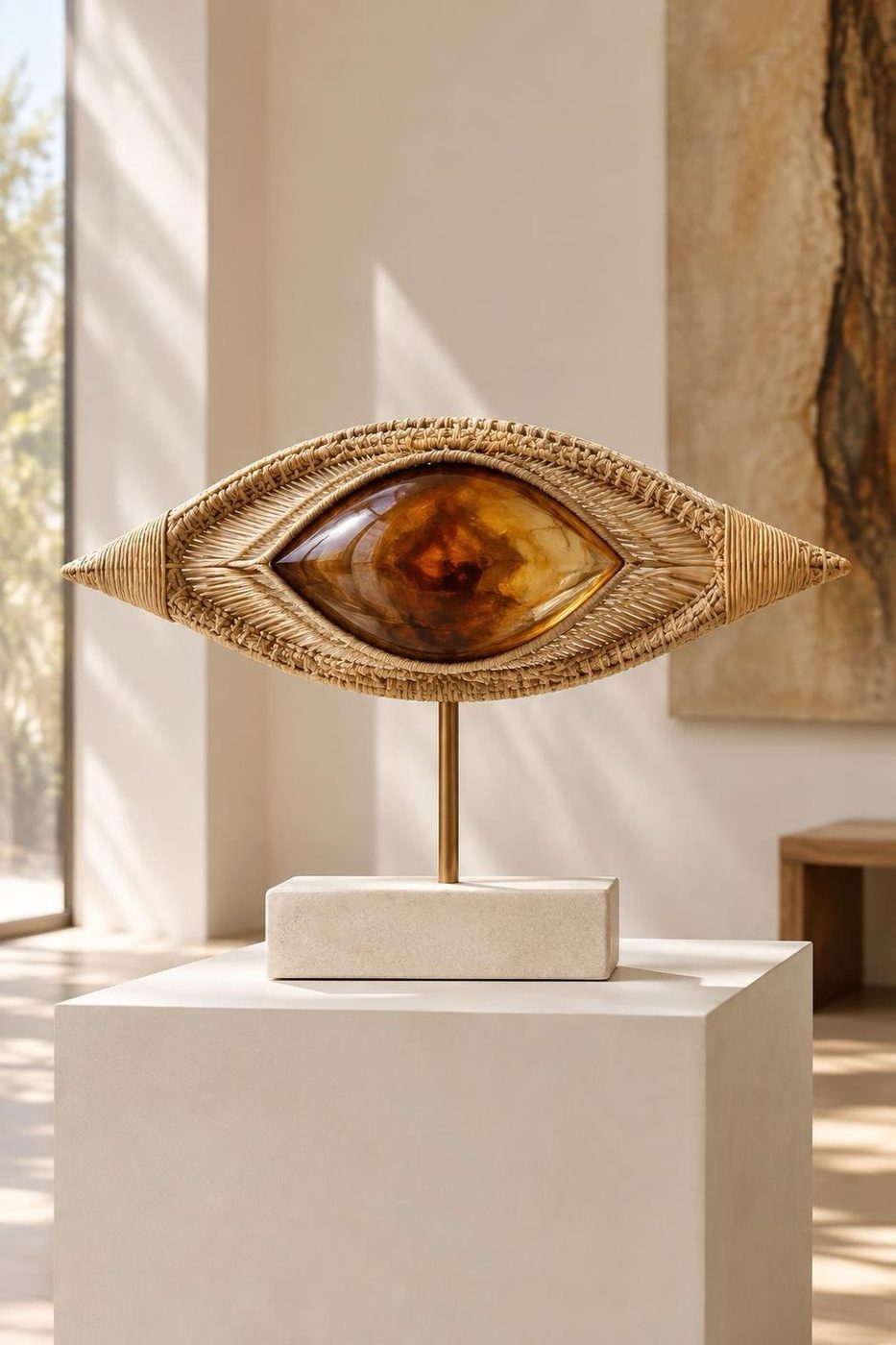
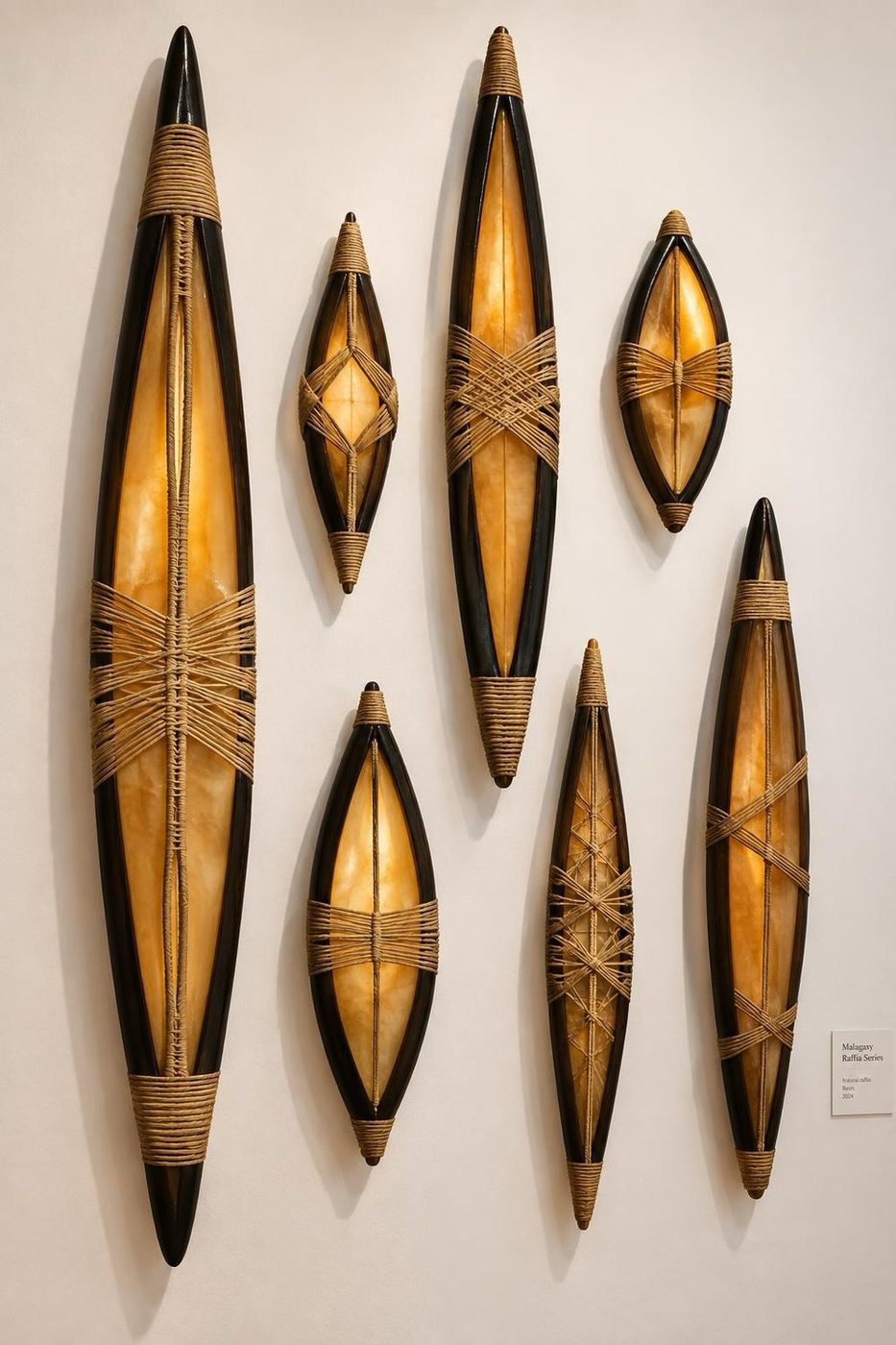
OCULI begins here. Each piece is a lens, a pupil, a hull of light: the shape of that luminous ball and, at the same time, the shape of the eye that saw it. Woven raffia for the eyelid, cast resin for the light.

The Fibre
Raffia (Raphia farinifera) is the palm of the humid forests along Madagascar’s eastern coast. From its young, still-closed leaves comes a fibre that is long, soft and remarkably strong: it is stripped by hand, dried in the sun and woven according to techniques handed down within families. Madagascar is the world’s leading exporter of natural raffia. Every OCULI structure is woven by Malagasy craftswomen in Nosy Be, the island off the north-west coast of Madagascar where Raphia & Résine has its own showroom & atelier — the twin of SpazioAlieno.Art’s in Milan: here the structures take shape and the finished pieces come back to be seen, a few steps from the sea. Here the raffia is not a covering: it is the skeleton of the piece — eyelid, lashes, hull. The weaves change from piece to piece: twisted cord, herringbone, open net, knotted band, cane-work.
No chemical treatment. The fibre stays natural, the colour of the sun that dried it.
Baobab, western coast of Madagascar.
The Lens
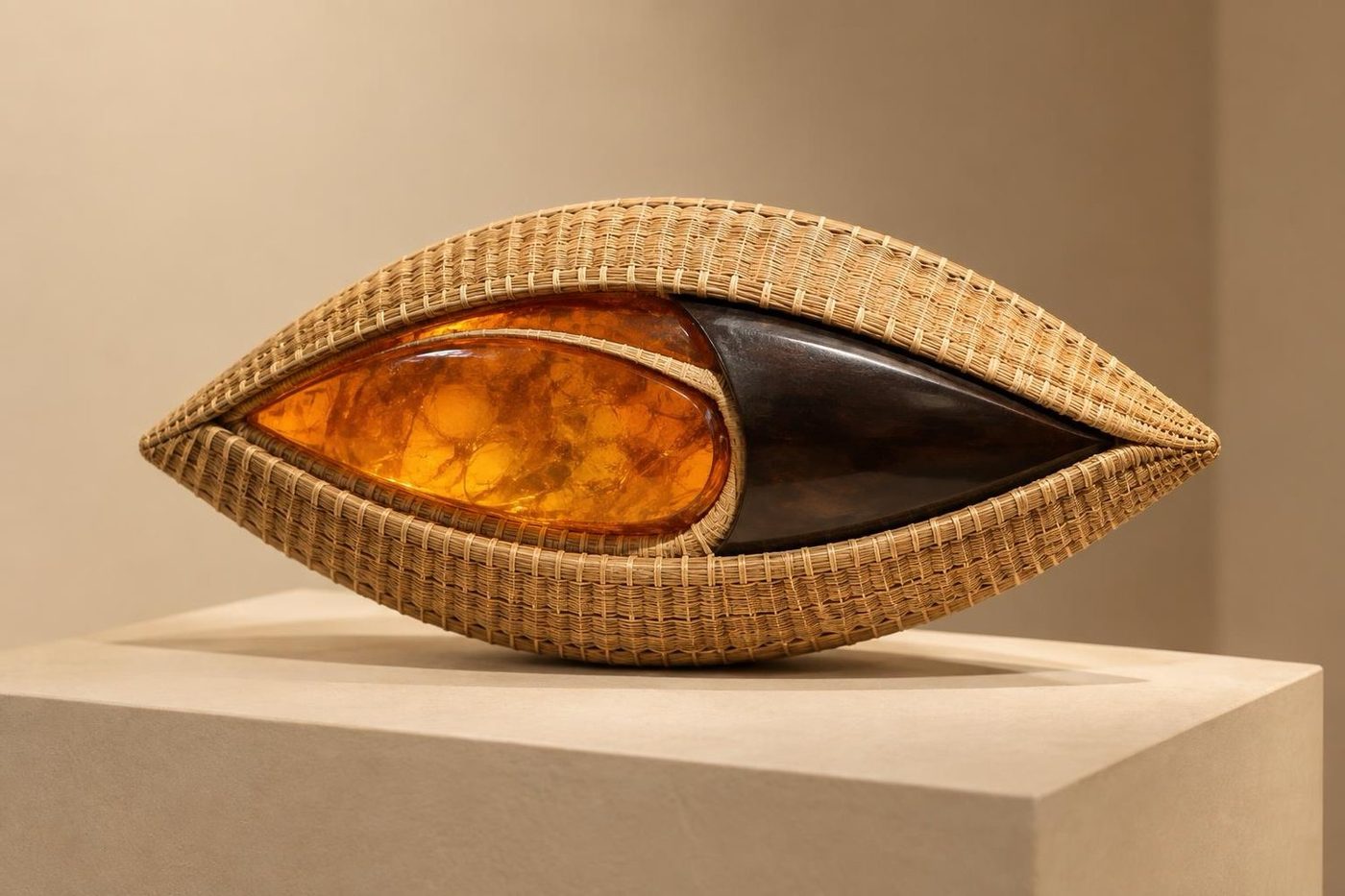
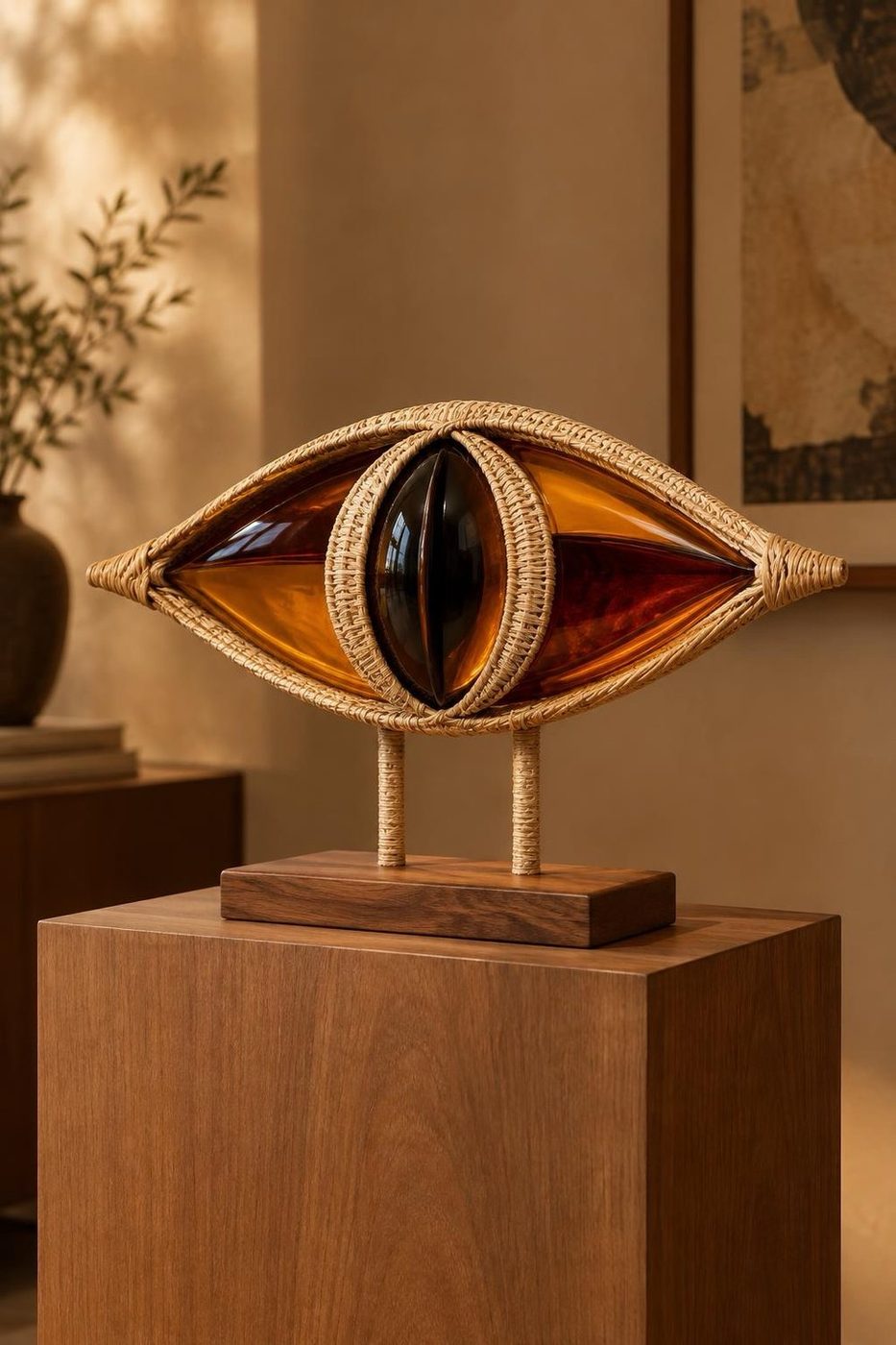
The lenses are cast by hand in the Milan atelier of SpazioAlieno.Art. Pigmented epoxy resin, poured in successive layers to obtain the veining of amber — the Ambra Aliena that gives the first series its name —, of tortoiseshell, of smoke; then sanded with ever finer grit and polished to a mirror finish. The pupil is a second, darker pour, set into the first.
The bases are in brass, black walnut, travertine and burnished bronze, worked by Italian craftsmen.
The meeting happens on the workbench: the structure arrives from Nosy Be, the lens is born in Milan, the piece is closed, wired when it is a light, and signed. Two ateliers, two islands, one signature.
ARCA — fully woven body, amber lens and ebony resin.
The Design
Gianluigi “Jan” Ruju, Milanese designer and craftsman, is the founder of SpazioAlieno.Art, home of the SELLONE and TANKONE collections. For years he has worked on the boundary between sculpture and functional object, in a language he calls alien: organic forms, honest materials, a certain elegant unease.
The roots are Sardinian: the Ruju family comes from Lula, at the foot of Monte Albo, in the Barbagia of Nuoro. In that Sardinia, women still weave asphodel and dwarf palm into baskets and corbulas, and the eye has always been a sign of protection: against s’ocru malu, the evil eye, the ancient words are still recited. OCULI carries that eye-amulet and that gesture of weaving from the island in the Mediterranean to the island in the Indian Ocean.
The Malagasy hand weaves, the Sardinian hand remembers, the Milanese hand casts and polishes; the design holds the three together. All the pieces are unique: woven and cast by hand, numbered, signed and certified by the artist Jan Ruju. No two are alike, and none ever will be.
The series
Every piece is woven in Nosy Be, cast and signed in Milan. No editions: each sculpture and each lamp exists only once.
The series
The lenses are cast by hand in the Milan atelier of SpazioAlieno.Art. Pigmented epoxy resin, poured in successive layers to obtain the veining of amber — the Ambra Aliena that gives the first series its name —, of tortoiseshell, of smoke; then sanded with ever finer grit and polished to a mirror finish. The pupil is a second, darker pour, set into the first.
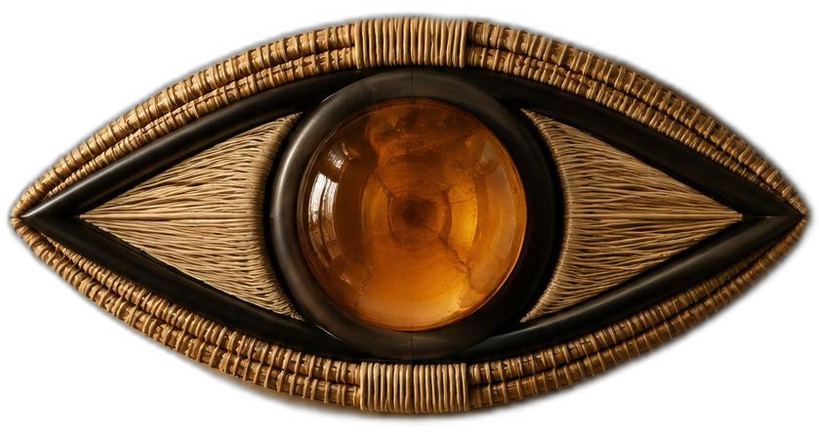
Eyes and spindles for the wall · 7 pieces
Backlit wall lamps · 3 pieces
Sculptures on a base · 8 pieces
The Red Series
From the sky, Madagascar is red. The laterite of the highlands — the iron-rich earth that the rains wash down to the sea and that stains the rivers — has given the island its name: the Great Red Island. On the evening of 16 August 1954, the green object passed over that red earth.
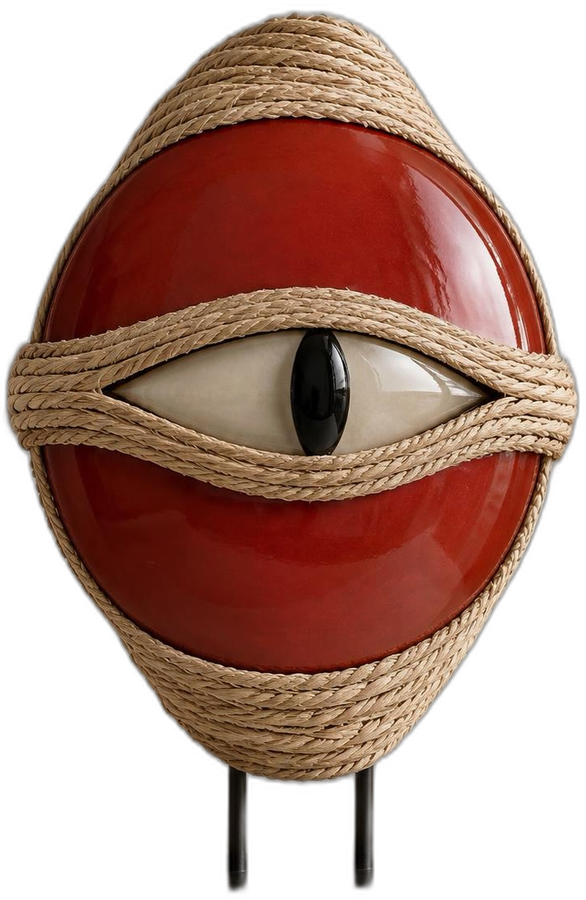
RUBRA is the earth looking at the sky. Here the resin is no longer a transparent lens but a solid body: laterite red cast in mass, sanded and polished until it looks like enamel. Within it, a single slit — white, black or of light — is the only opening to the interior.
The forms become spheres and eggs: globes, not hulls. The raffia does not frame them, it wraps them: it binds them, cradles them, holds them upright. The lamps of the series light the pupil, and the red sphere stays dark around the light, like the earth around a fire.
SPHAERA — the sphere. Base in burnished steel.
Sculptures of the red series · 9 pieces
Lamps of the red series · 10 pieces
The Weaving Series
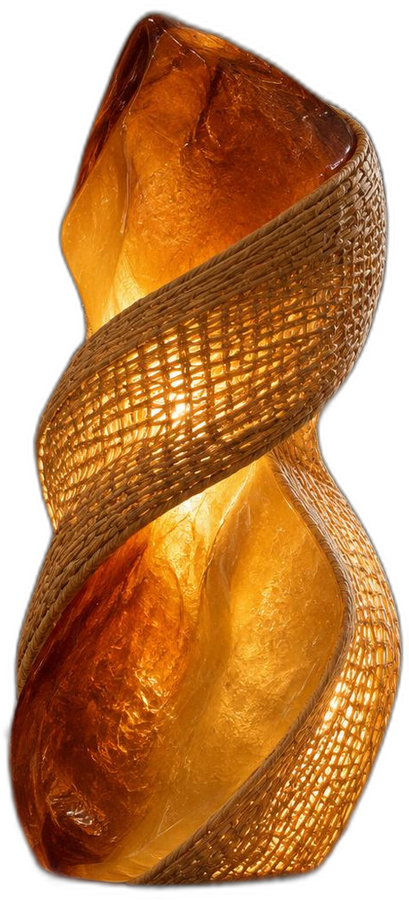
Here the eye closes and the light remains. NEXUS is the series in which the raffia stops framing and begins to bind: it knots, crosses and rolls itself around a heart of hand-cast amber resin — a boulder, a wave, a shell, a leaf. The resin is cast in open moulds, without a pupil, with veins and clouds left to surface; the light sits inside and passes through amber and fibre together. Each piece is born of a single gesture of the craftswoman — the knot, the band, the spiral — and that gesture gives it its name.
Table lamps and wall lamps: the most domestic pieces in the collection, the ones kept beside the bed or in a corridor, lit in the evening.
CONTORTA — the twisted one.
Lamps of the weave · 16 pieces
The Lamba Series
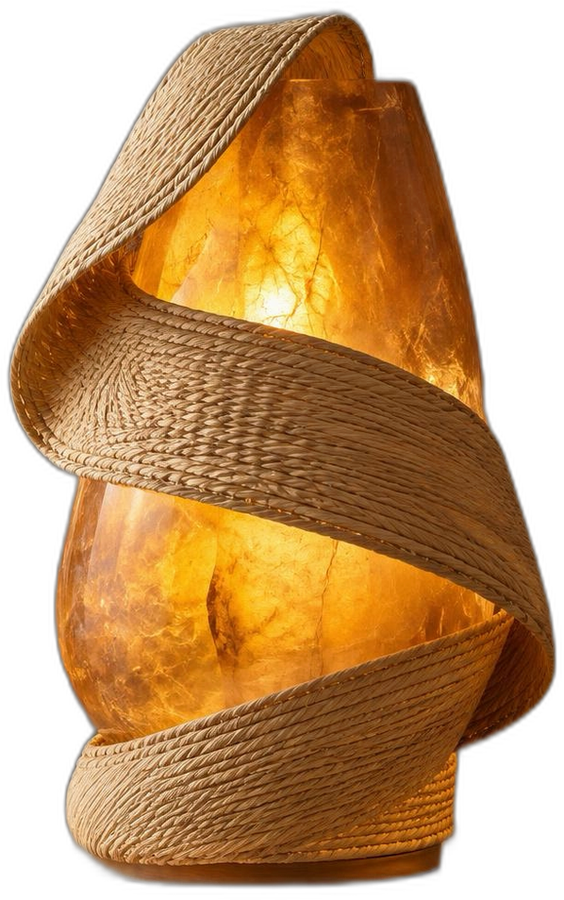
In Madagascar the lamba is the cloth worn over the shoulders: a rectangle of fabric that is wrapped, knotted and draped in a single gesture, and that accompanies a person from birth to the final journey. SPIRA is born of that gesture.
A wide band of woven raffia — flat, soft, almost a fabric — spirals around a body of amber resin as the lamba wraps the shoulders. There are no knots and no frames: only the turn of the band, once, twice, three times, and the light that escapes where the band leaves the amber uncovered.
It is the simplest and most Malagasy series in the collection. The raffia is woven in Nosy Be in continuous bands, then rolled onto the resin body in Milan; the resin is cast paler and more transparent than in the other series, because here it has to show itself.
LAMBA — the mantle.
Lamps of the lamba · 10 pieces
The Glass Series
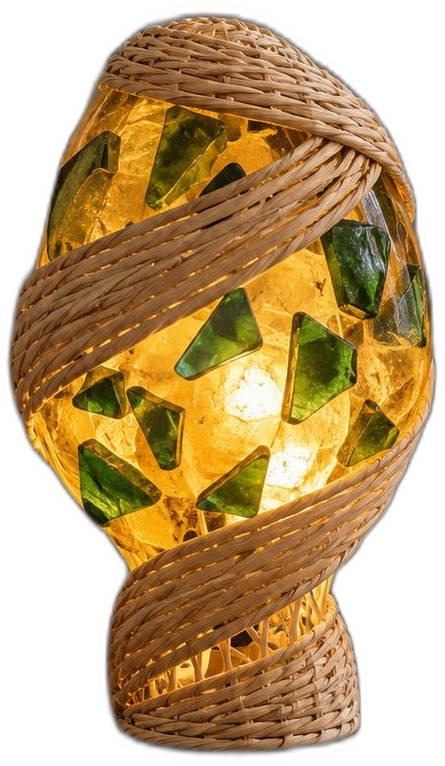
On the beaches of Madagascar the sea gives back glass: shards of bottle smoothed by the sand, green as raffia leaves, amber as rum. RIFLESSA is born of those fragments. Reclaimed glass — bottles, window panes, glassworks offcuts — is broken, washed and cast into the amber resin, where it stays suspended as in a block of ice. Lit, the light passes through the resin and refracts in the fragments: every shard of glass is a green mirror, and the lamp casts around itself a rain of reflections that move as you move. Hence the name — riflessa, the light reflected and the light that reflects.
Here the raffia is minimal: a collar, a band, a nest. It holds the block of glass and resin the way one holds a heavy fruit. It is the brightest, most colourful and most sustainable series in the collection: no fragment is made on purpose, all of them come from something that was already broken.
SPECULUM — the mirror.
Lamps of reclaimed glass · 16 pieces
The Mosaic Series
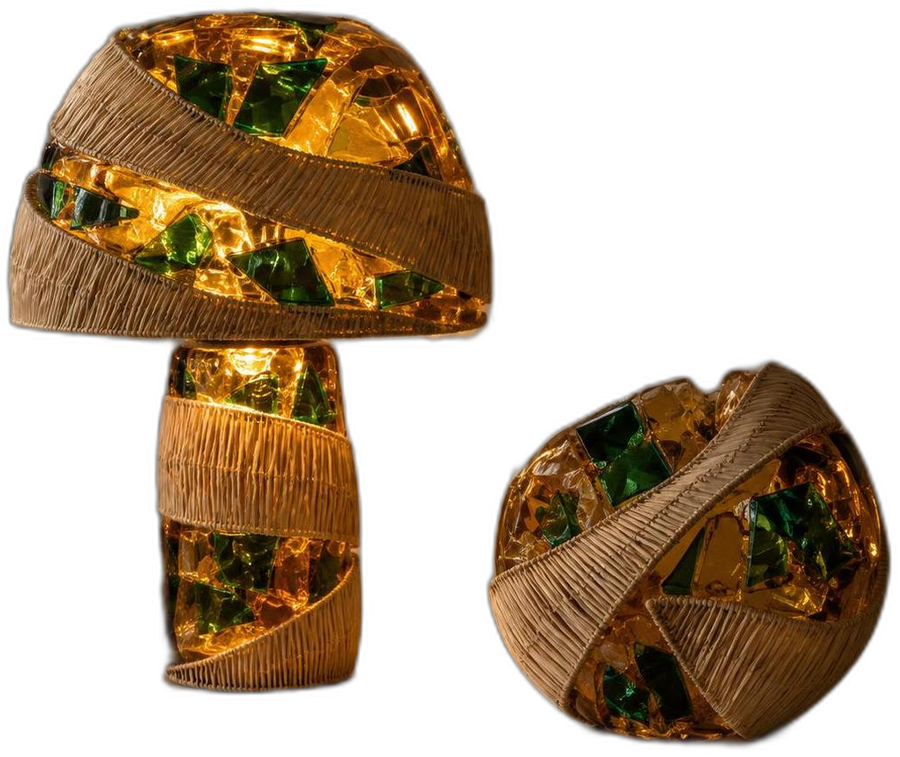
If RIFLESSA is the glass found on the beach, VITREA is the glass brought into the workshop. Here the fragments do not float in the resin: they are cut into tesserae, set side by side as in a mosaic and cast at the surface, where the light passes through all of them together. Bottle green, amber, gold, a little ruby.
The forms are the ones everyone recognises — the mushroom, the lampshade, the amphora, the lantern — because the mosaic needs a simple surface to be read. The raffia returns to discipline: a collar at the top, a band at the bottom, a spiral that turns only once.
It is the series that speaks of Milan: of the glass of the city’s windows and mosaics, carried to the island and brought back home. Every tessera is reclaimed glass, cut and laid by hand; lit, the lamp is a small stained-glass window for the table.
MEDIOLANUM II — the stained-glass window onto the Duomo.
Lamps of the mosaic · 18 pieces
XI · The resin palette
Ambra Aliena is the collection’s principal voice: it is the colour of baobab resin, of sunset over the upper town, of the light filtering through raffia. Laterite red is the voice of the RUBRA series. But the lens can be cast in other tints, all obtained by pigmentation in the mass and layering. Every tint is available on all wall and tabletop models, with a black pupil or, on request, in a tint darker than the lens.
Every tint is available on all wall and tabletop models.
Authenticity
Every OCULI sculpture and lamp is numbered progressively — №001, №002, №003 — in a single, infinite series opened in the history of the collection. The number is laser-engraved on a brushed brass tag with a QR code that opens the online certificate: hung on a chain on wall pieces and pendants, fixed to the base on sculptures and table lamps. The certificate confirms the authenticity of the piece; the register is kept by the SpazioAlieno.Art atelier in Milan.
No piece is like another. The raffia is hand-woven in Nosy Be, the resin hand-cast in Milan: the engraved tag and the numbered certificate do not attest an edition, they attest a piece that exists in one single example, signed by Jan Ruju. Every model is an original design by SpazioAlieno.Art, protected by copyright and with a certified date.
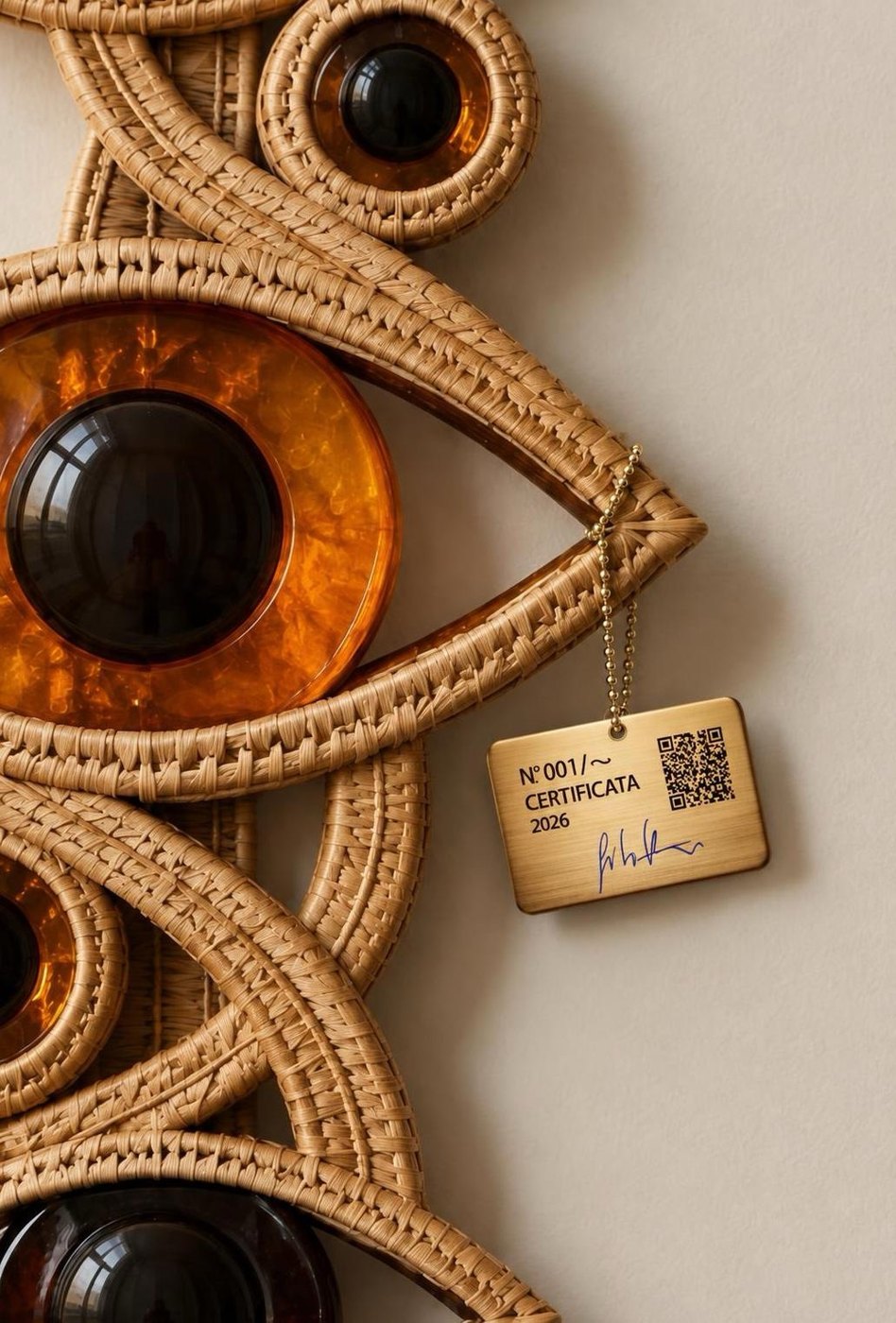
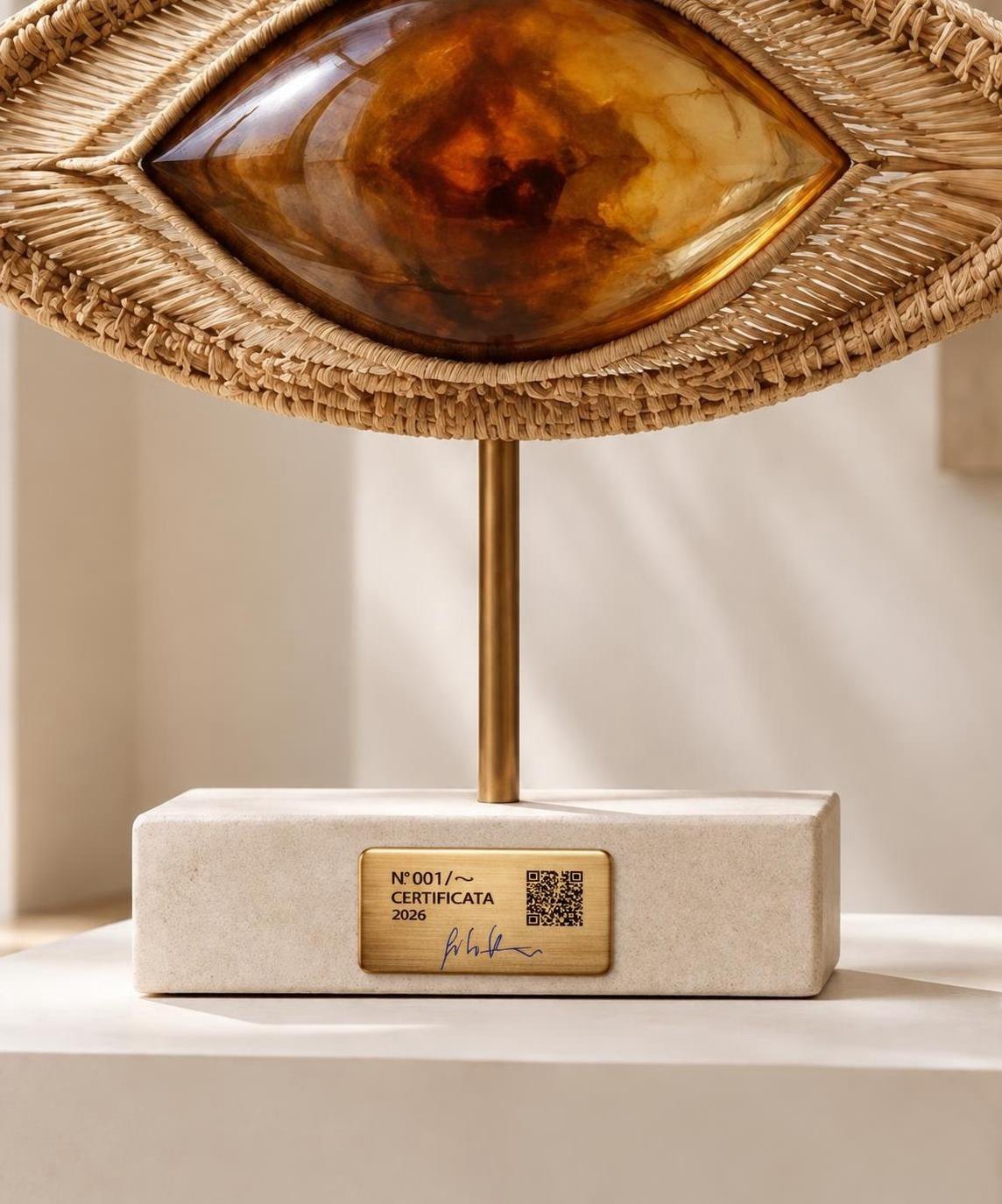
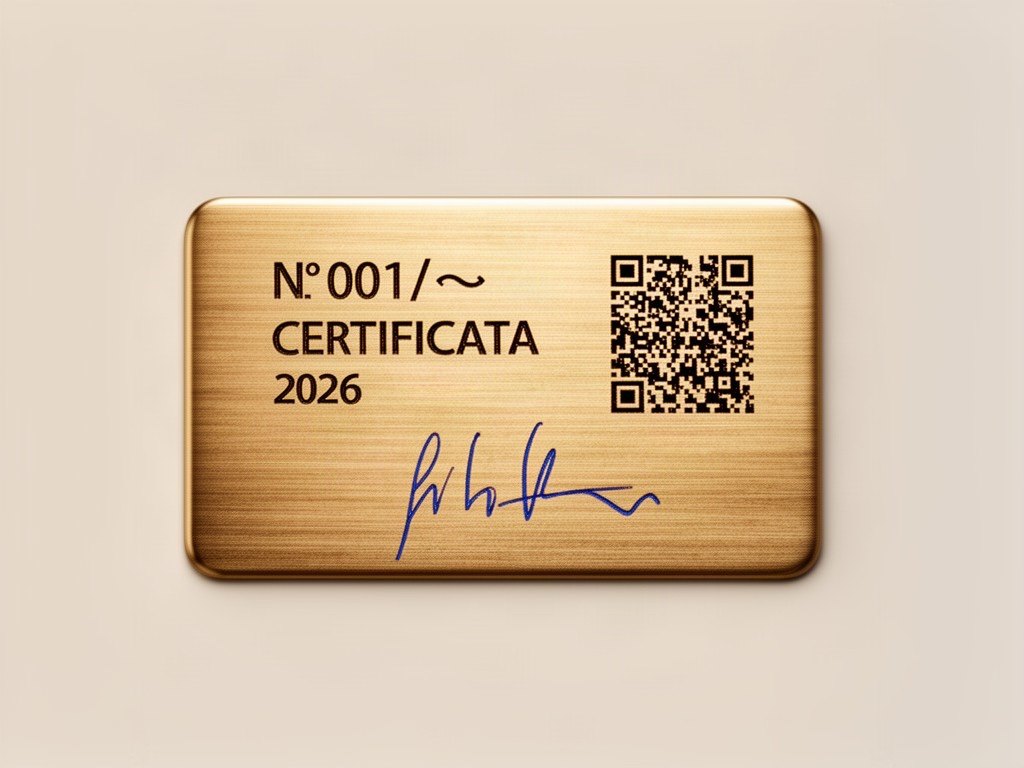
Brass tag with progressive number, year, certificate QR and signature: hung on its chain or fixed to the base.
Numbering
Progressive across the whole collection, from the first piece onwards. The number stays the same forever.
Tag
Hung on a chain on wall pieces, fixed to the base on table pieces. Number, year, QR and signature.
Certificate
Scan the tag and receive confirmation of authenticity — always, from any device.
The studio
Alongside the collection, a design studio that shapes the space around the pieces: from rendering to light design, to hand-made resin surfaces.
We design and render in 3D hotels, restaurants, shops, offices and private homes, simulating the placement of OCULI lamps and sculptures in the client's real space — before a single piece is made.
A personalised study of light: colour temperature, intensity, shadows and reflections of each piece, calibrated to the space, the materials and the use — a lobby, a dining room, a bedroom.
Design and execution of wall coverings and artistic flooring in epoxy resin: seamless surfaces, poured and worked by hand, as unique as the sculptures. Over twenty-five years of practice.
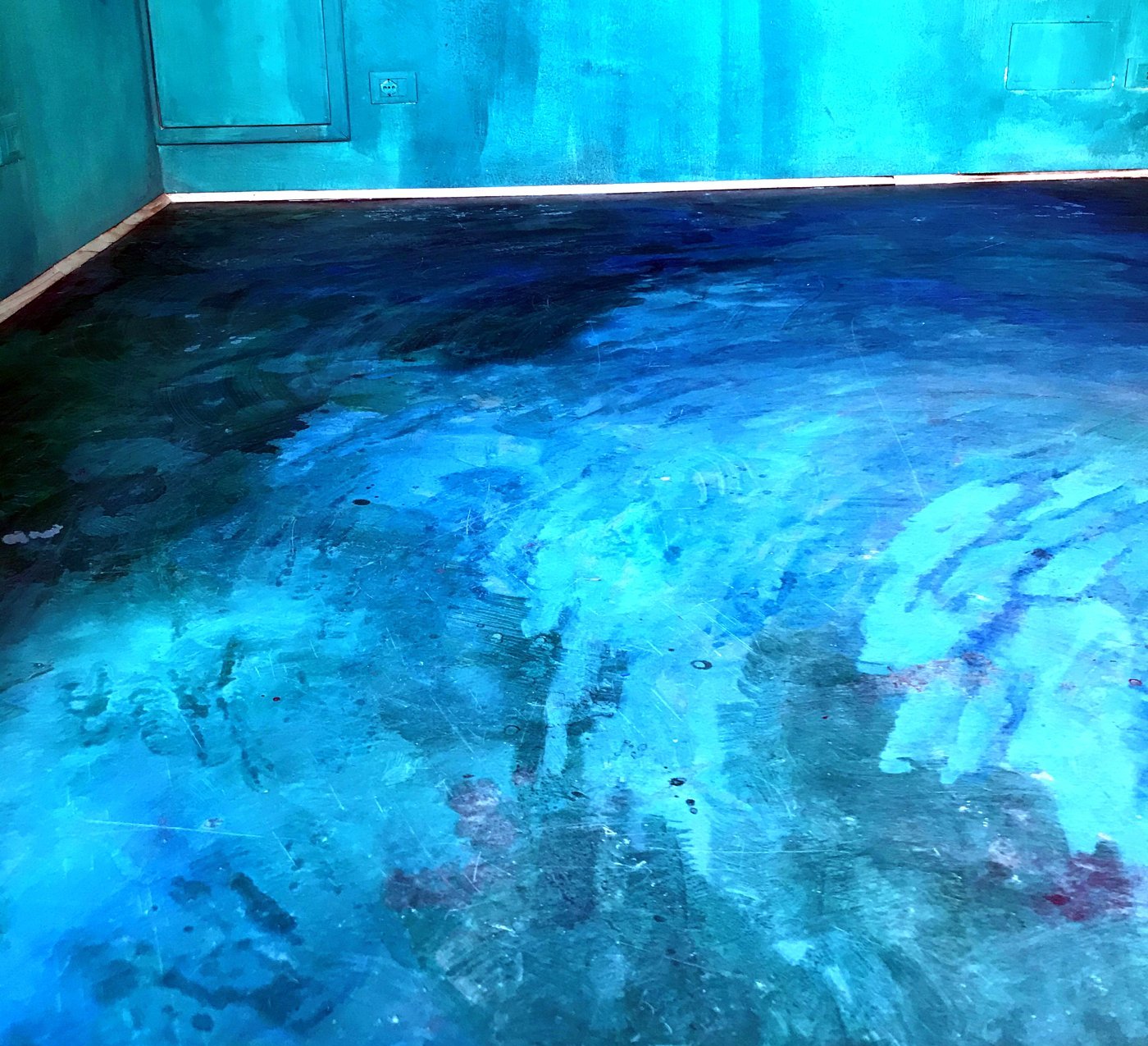
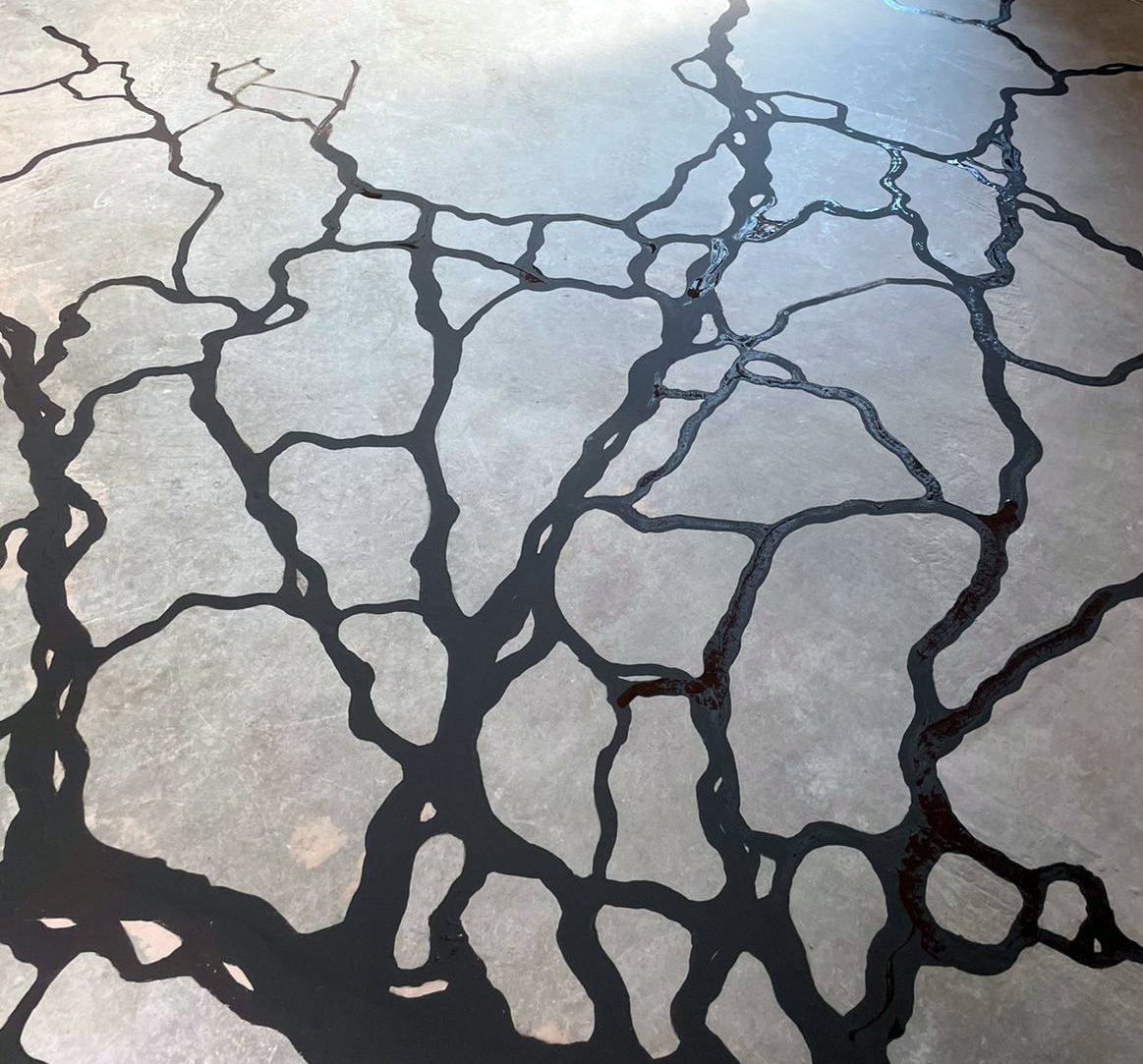
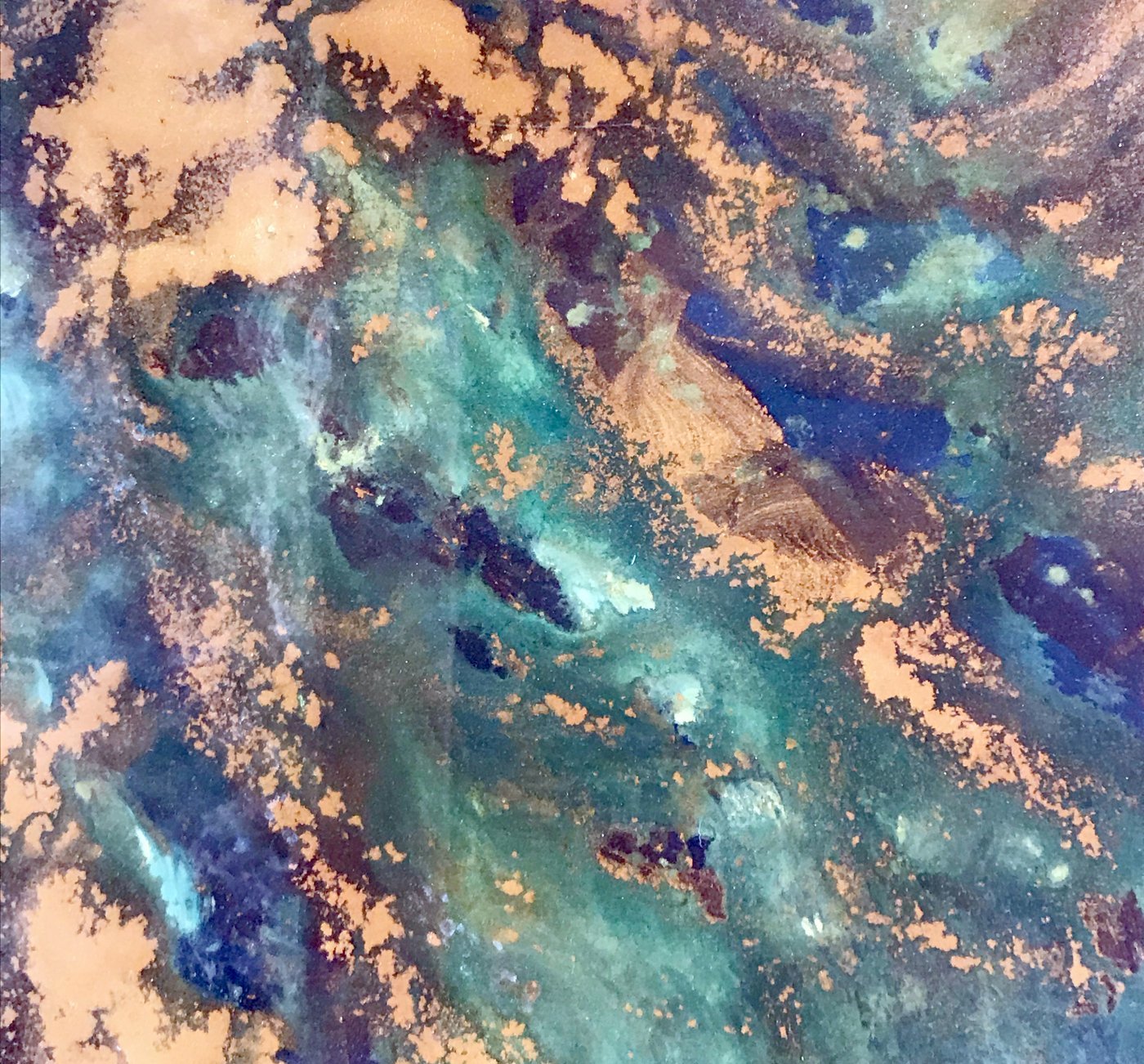
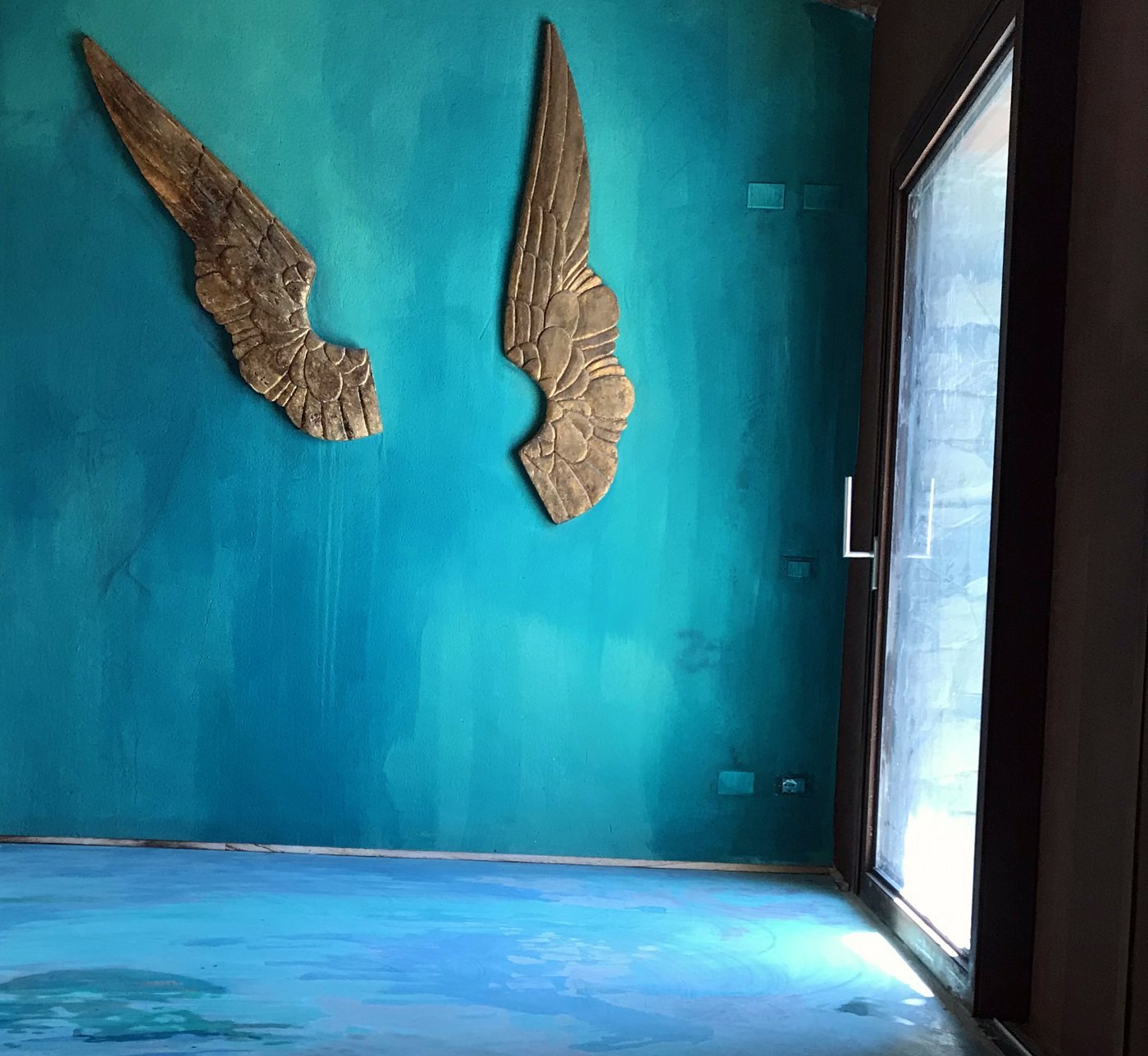
Resin floors and walls — Eco del Mare, Lerici
The Position
As far as we know, no maison, no studio, no craftsman — in Europe, in Africa, anywhere — has built an identity on the union of natural raffia and resin. There are bijoux with cabochons, lampshades on resin bases, vintage American objects in encapsulated fibre. There is no collection.
There is, however, a genealogy, and it is Italian. Gaetano Pesce, Golgotha 1972, glass cloth impregnated with resin for Bracciodiferro and Cassina; Feltri 1987, wool felt and polyester resin.
Then Wanders, Carbonell, Gimbrère: all fibre and resin, none with raffia.
OCULI takes its place in that line and changes the material, choosing the most Malagasy fibre there is. Madagascar supplies around 80% of the world’s raffia; Italy is already the third-largest importer of finished Malagasy weaving. The supply chain existed. What was missing was the signature.
The artist
«My hands do not touch screens, they shape matter. They are marked by resin, tempered by iron, hard as rock.»
Gianluigi “Jan” Ruju was born in Milan on 19 January 1967, to a Sardinian family from Lula (Nuoro). He grew up between the Lido and Monte Stella, “an island of meadows and trees that escaped the concrete”; his first work, at the age of eight, was a system of miniature canals built with twigs from the garden. From then on, he says, he never stopped: taking apart, putting back together, creating.
After art school, in 1987 he joined Forum Colorum, the technology start-up of the Herberts-Hoechst group where colour met the computer for the first time: on Silicon Graphics workstations — the same ones used for Roger Rabbit — he designed in 3D for Alfa Romeo, Mercedes, Volkswagen and BMW. It was there that he learned colour applied to matter, and resin as the skin of things.
Since then his path has run on two tracks that cross constantly: the creative enterprise — computer graphics, events, installations in Italy, Spain, Austria and the Principality of Monaco — and sculpture. From 2000, the EJan sculpture-rings, unique pieces in reclaimed materials; from 2014, Il Resinismo, an international collective of resin artists; the Alien Sculptures, organic forms lit from within, from ten centimetres to five metres; SELLONE, historic saddles that become seats. In 2007 he created Puzzle4Peace with Giuseppe Iavicoli at the Fuori Salone in Milan; in 2016 the Court of Milan granted it full copyright protection, a precedent in Italian contemporary-art law. Since 2017 he has directed SpazioAlieno.Art, a 522-square-metre workshop and gallery in Milan’s Parco Sud, where every one of his projects is born — and where, in 2026, OCULI is born.
Two ateliers, two islands
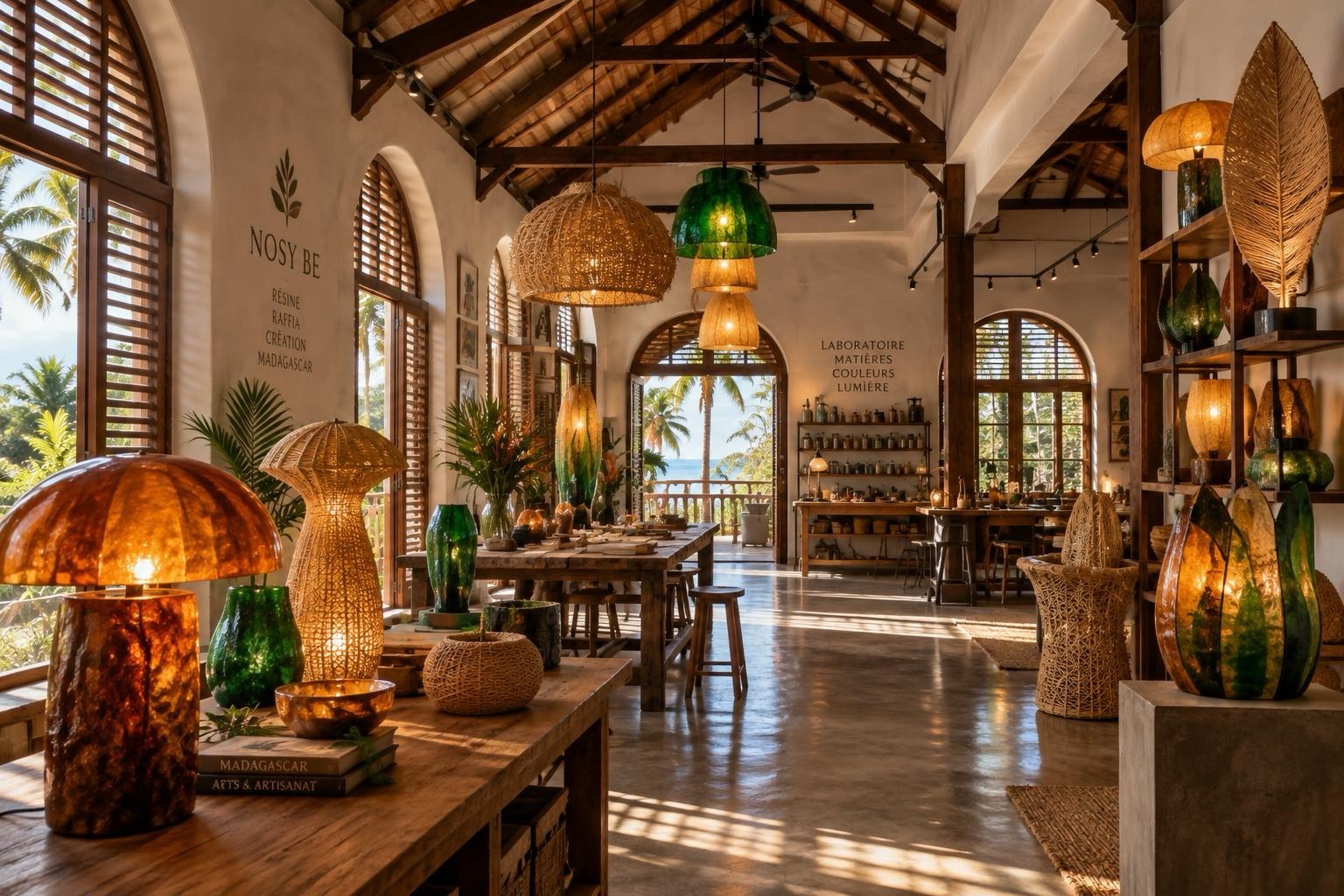
Madagascar · project renderings
These images are renderings: the premises Raphia & Résine will build in Nosy Be in the near future, investing in Madagascar. Here the raffia will be woven — eyelids, lashes, hulls, bands — and the finished pieces will come back to be seen, a few steps from the sea.
Italy · operating since 2017
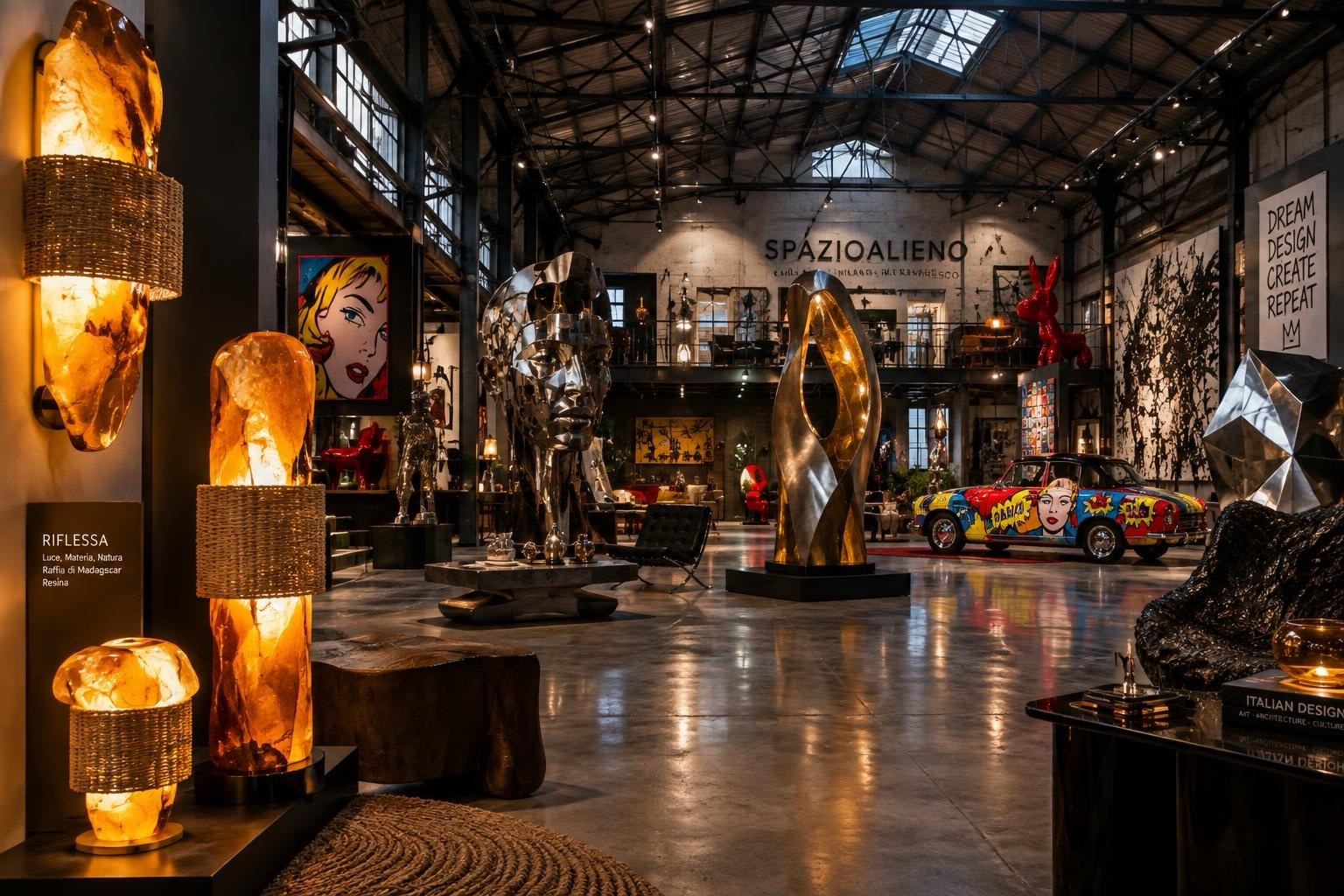
Operating since 2017 in the spaces of SpazioAlieno.Art and constantly evolving, it now also hosts this project. This is where the lens is born: hand-cast resin, bases in brass, walnut, travertine and bronze. The piece is closed, wired, numbered and signed.
SpazioAlieno.Art · Via Selvanesco 57, 20141 Milano
About us
Three people, two islands: design and resin in Milan, raffia and management in Nosy Be.

Founder & CEO · Design
Milan · Nosy Be

Management · Madagascar
Nosy Be · Antananarivo

Management · Madagascar
Nosy Be · Antananarivo
Contact
For information about a piece, to visit the showrooms, or for bespoke commissions.
Visits by appointment · SpazioAlieno.Art · Via Selvanesco 57, 20141 Milano
Coming soon on Kickstarter
minima, from the Latin: “the smallest things”
A new family of small objects of light in three sizes — 10, 20 and 30 cm — with the same alien gaze as OCULI: oxidised metal, raffia hand-woven in Madagascar and resin hand-cast in Milan. Each piece remains unique and numbered. The campaign opens on 30 March 2027; every euro beyond the goal builds the Nosy Be atelier.
Raffia binds, resin kindles, metal protects. Raffia and resin are present in every MINIMA piece: they are the glue that holds the structure together. The forms are born from the eye of OCULI and from the story of 16 August 1954, and fall into four types, from the smallest piece to the composition.
Table pieces · 10, 20 and 30 cm
Eleven forms to set down, each in three sizes. Three families: the forms of fire, the columns and the forms of the sea.
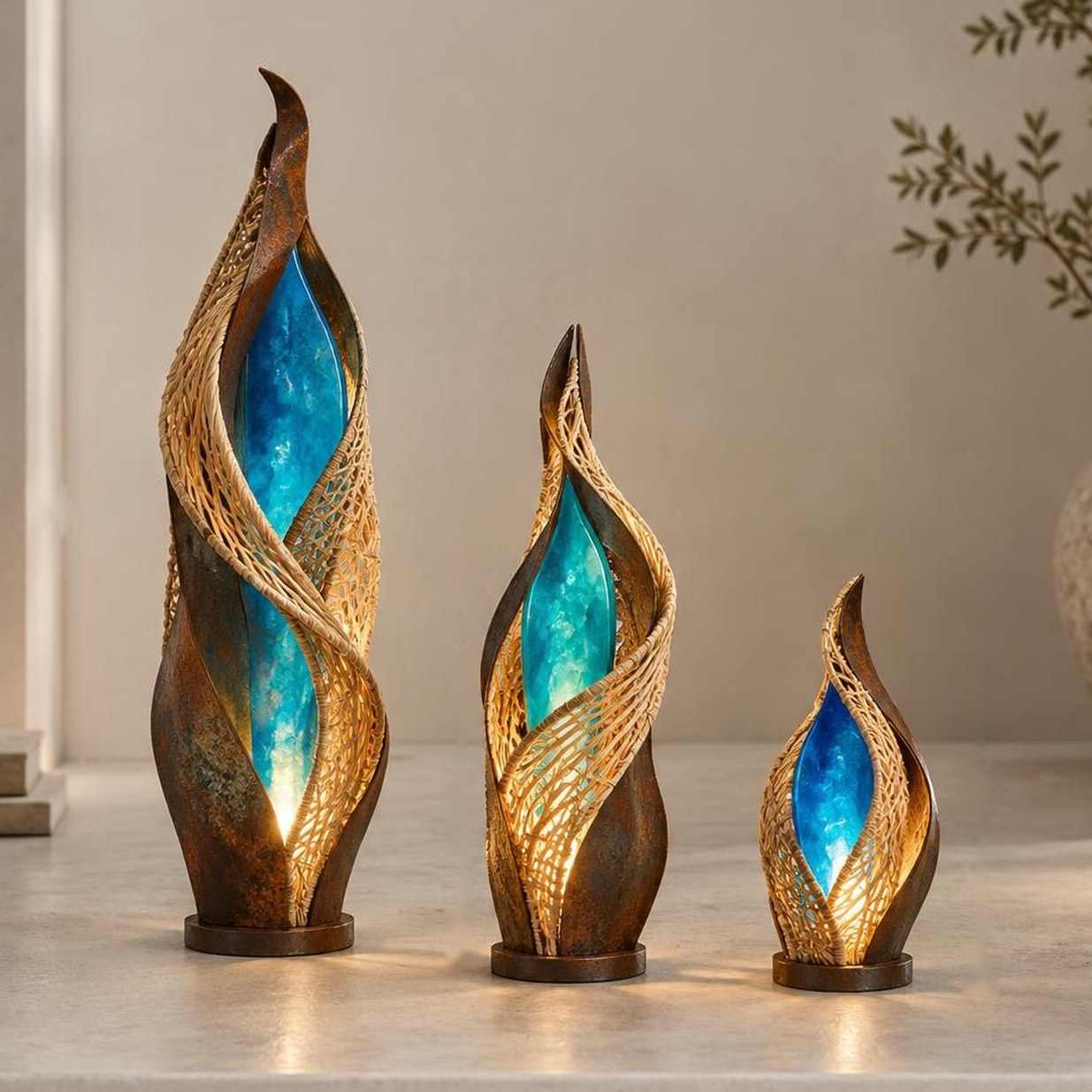
little flame
10 · 20 · 30 cm
A petal of oxidised metal curling like a flame around a heart of resin, with a band of woven raffia.
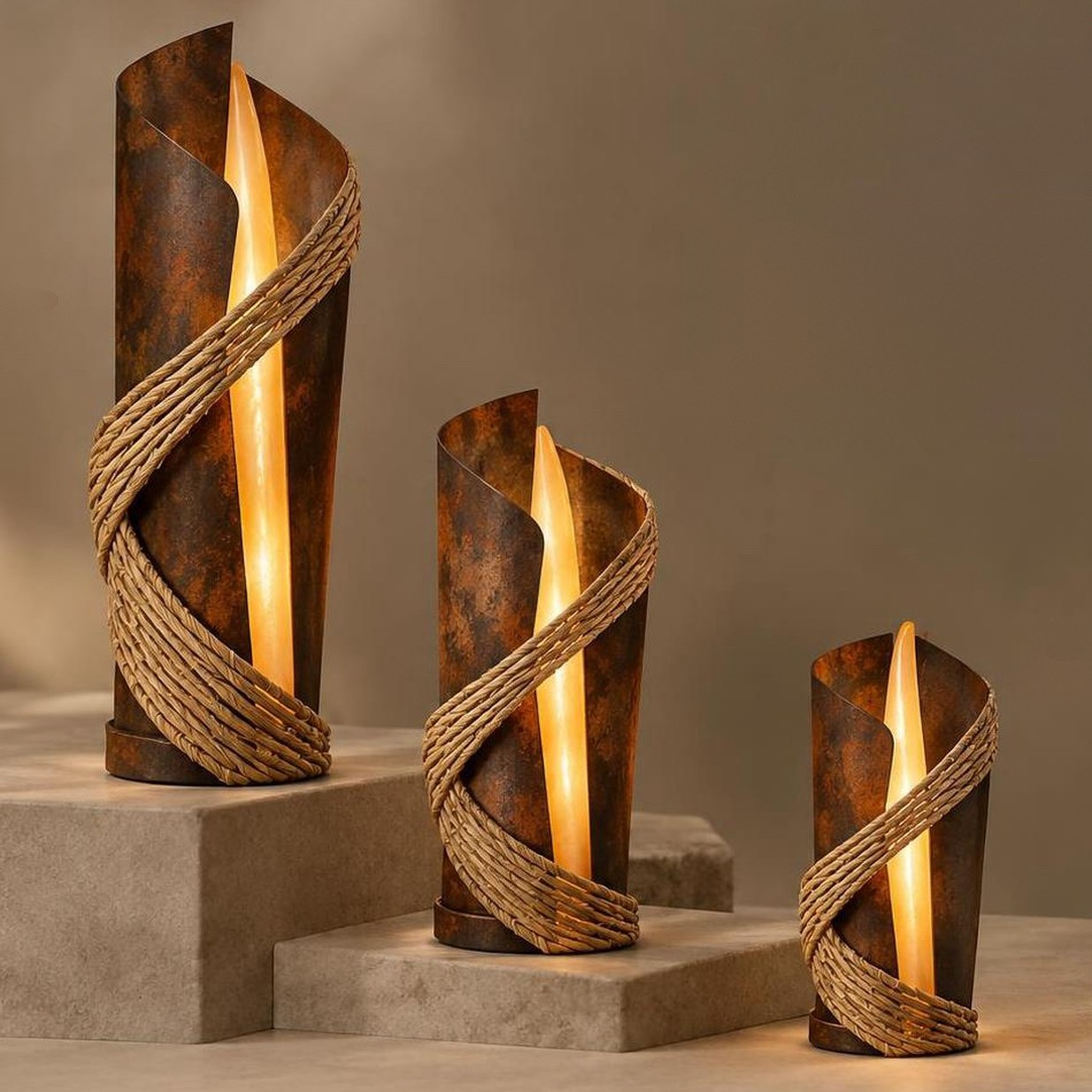
volute, scroll
10 · 20 · 30 cm
A rolled sheet of metal, a slit of light and a ribbon of raffia rising in a spiral.
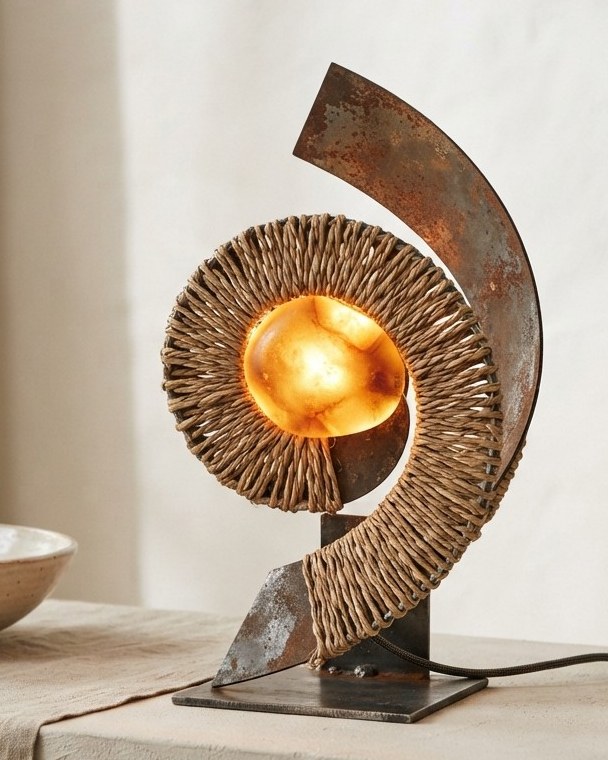
nautilus
10 · 20 · 30 cm
A spiral of metal and raffia around a sphere of amber resin, on a steel base.
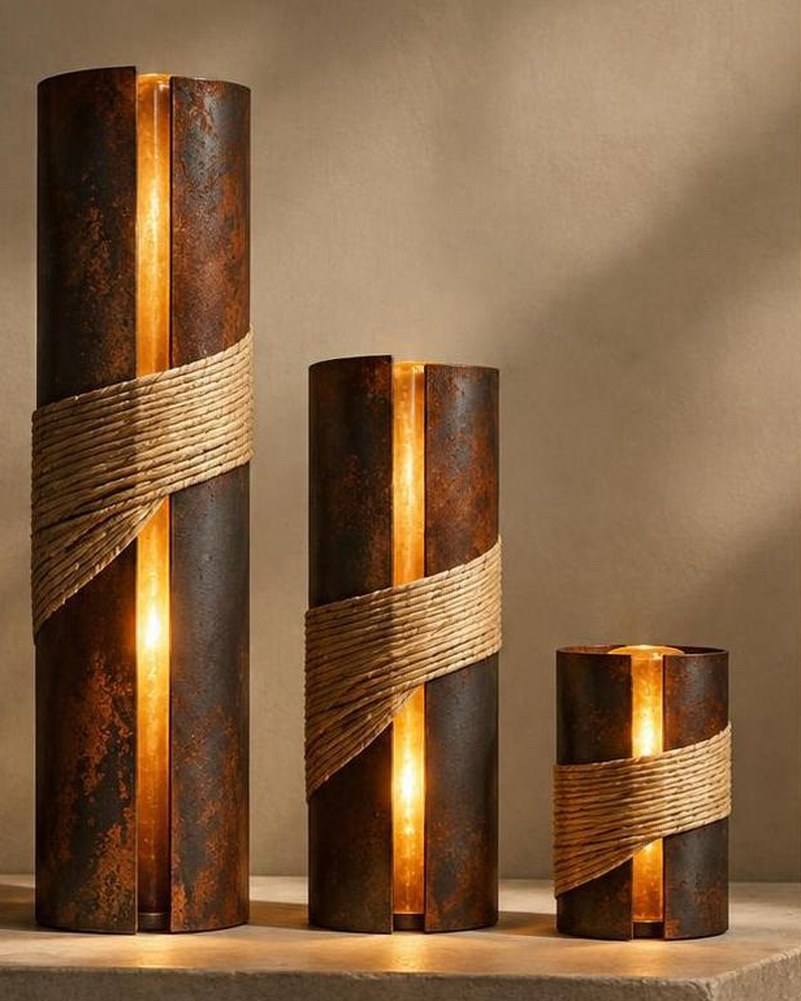
little column
10 · 20 · 30 cm
Two half-cylinders of oxidised metal opening onto a column of amber resin, bound by a band of raffia.
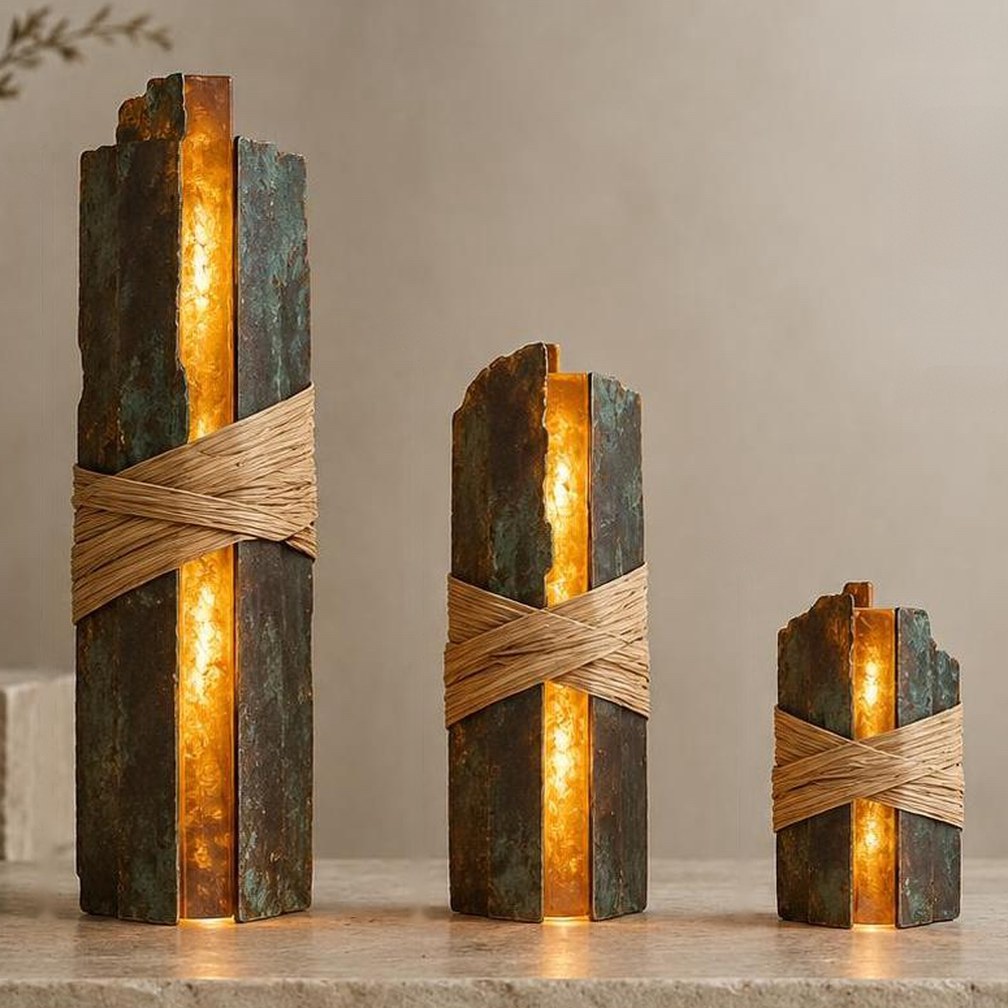
bark
10 · 20 · 30 cm
Plates rough as bark, green and rust patina, a vein of resin and a cross of raffia.
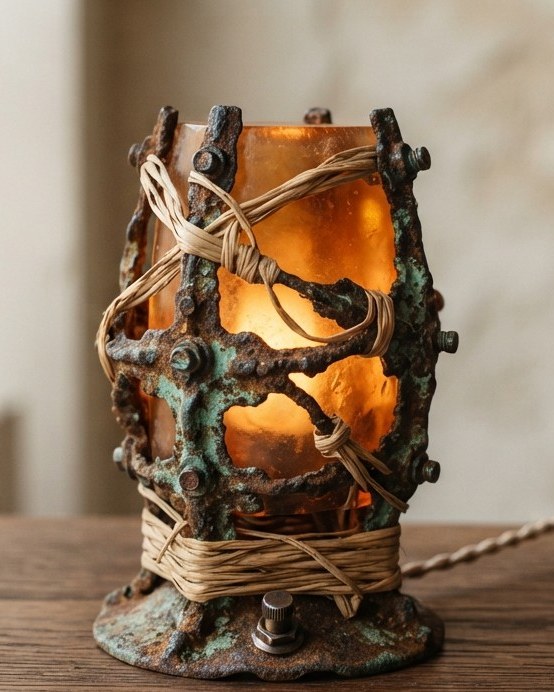
cage
10 · 20 · 30 cm
A cage of verdigris metal and bolts, bound with raffia, around a cylinder of amber resin.
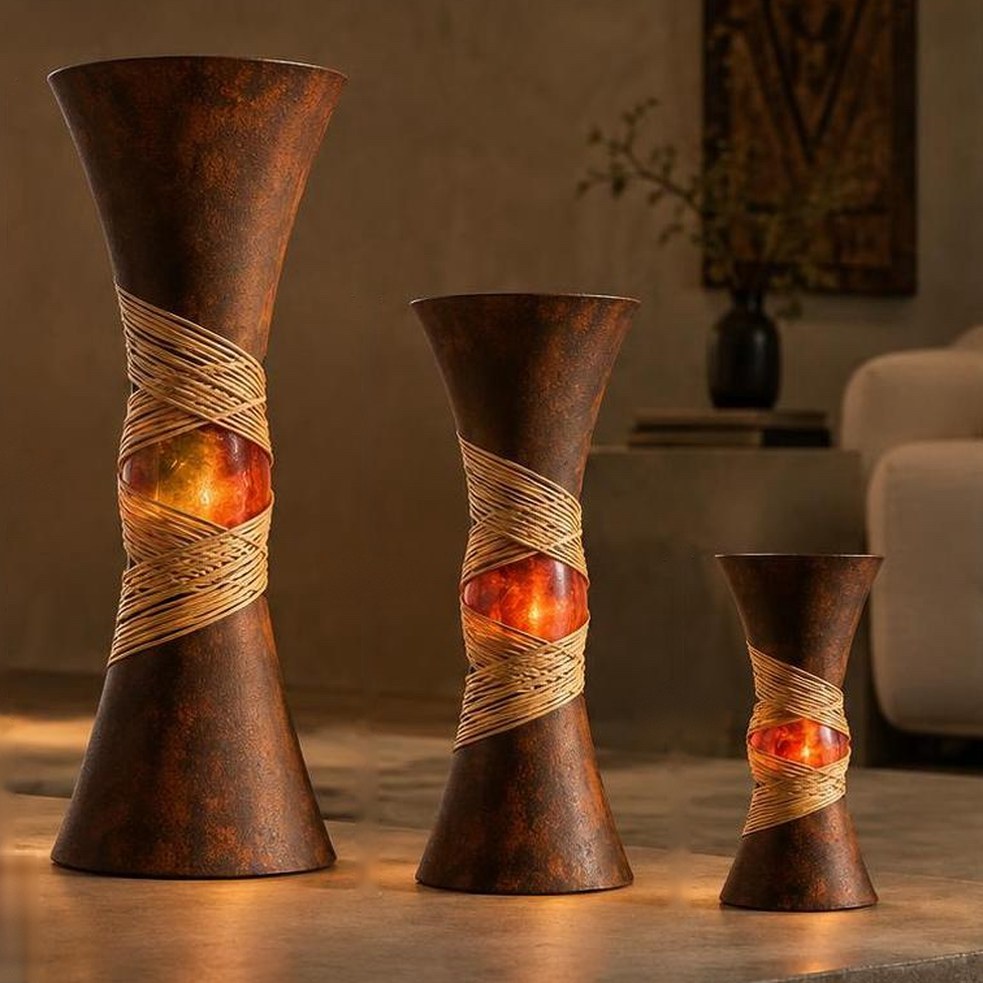
hourglass
10 · 20 · 30 cm
An hourglass of oxidised metal: at its centre, bound with raffia, a heart of red resin.
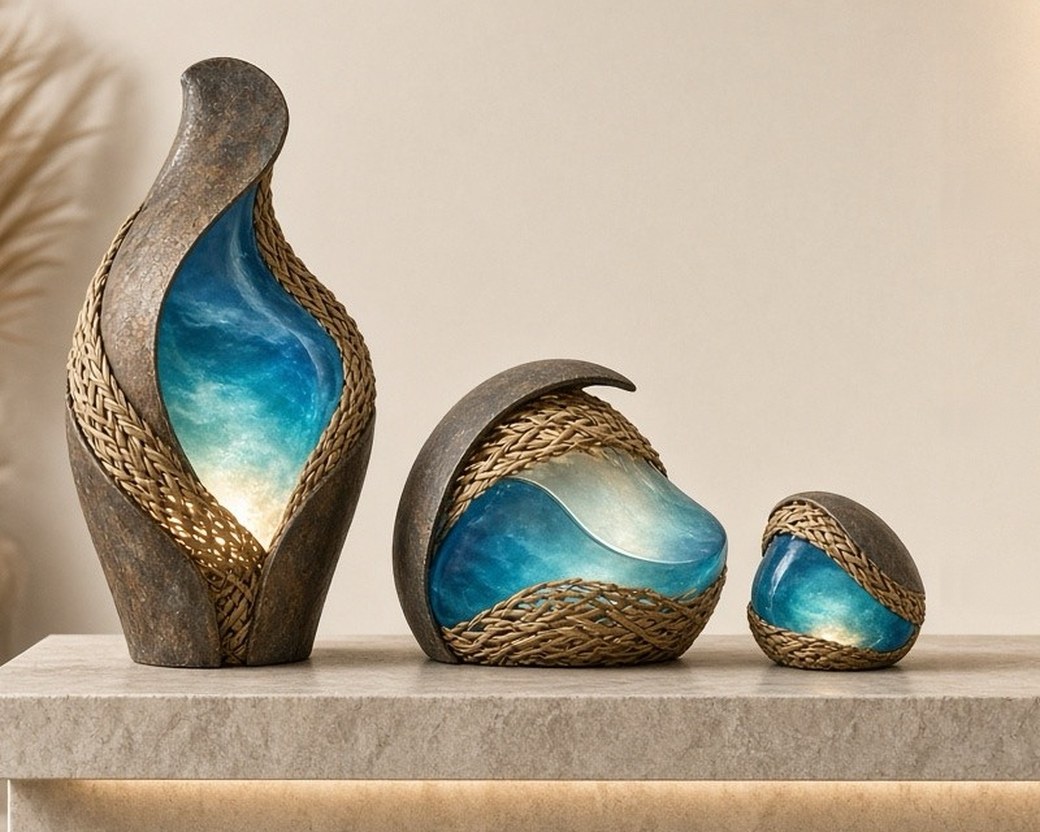
pebble
10 · 20 · 30 cm
Stones of patinated metal opening onto a sea-blue resin, edged with braided raffia.
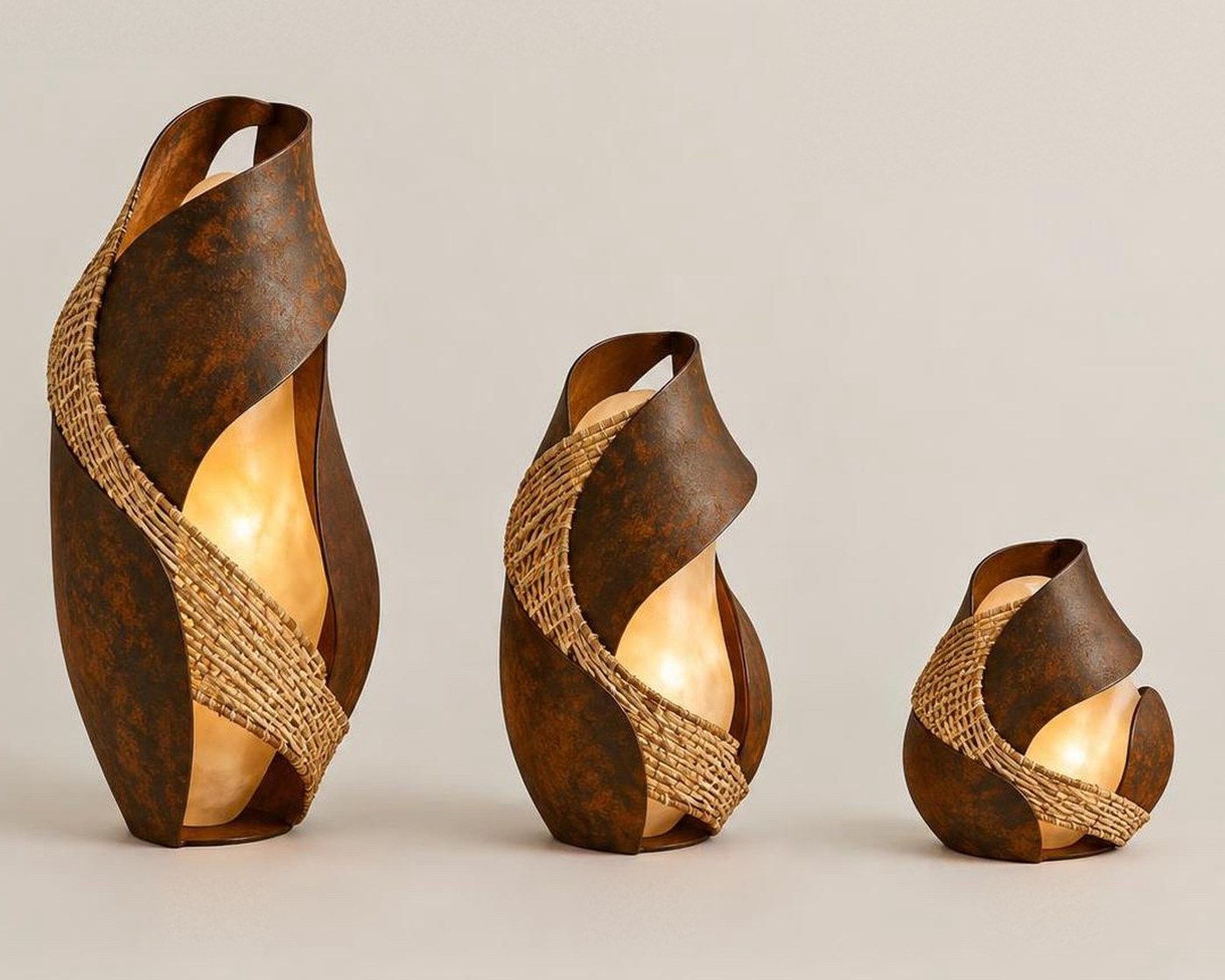
shell
10 · 20 · 30 cm
A metal shell enfolding a heart of milky resin, bound by a ribbon of raffia.
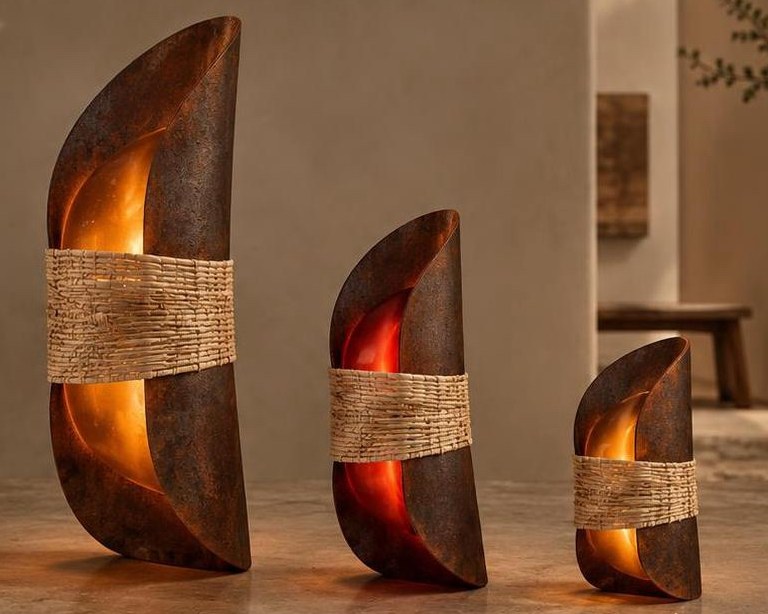
little moon
10 · 20 · 30 cm
A crescent moon of oxidised metal; a band of raffia encloses the amber or red light.
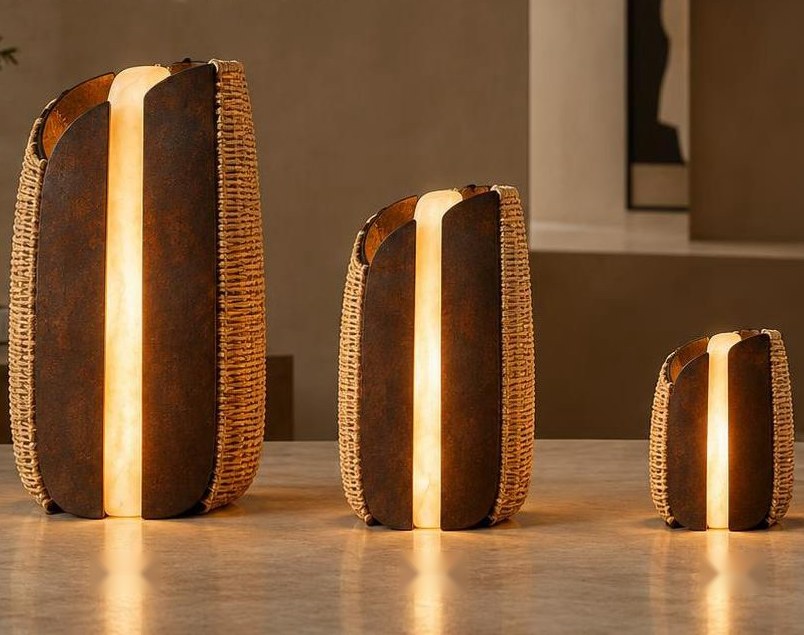
basket
10 · 20 · 30 cm
A basket of woven raffia with two metal valves and an upright blade of luminous resin.
Wall pieces · 10, 20 and 30 cm
Wall lights that hang like archaeological finds: a plate of metal, a slit of glowing resin, raffia stitching it to the wall.
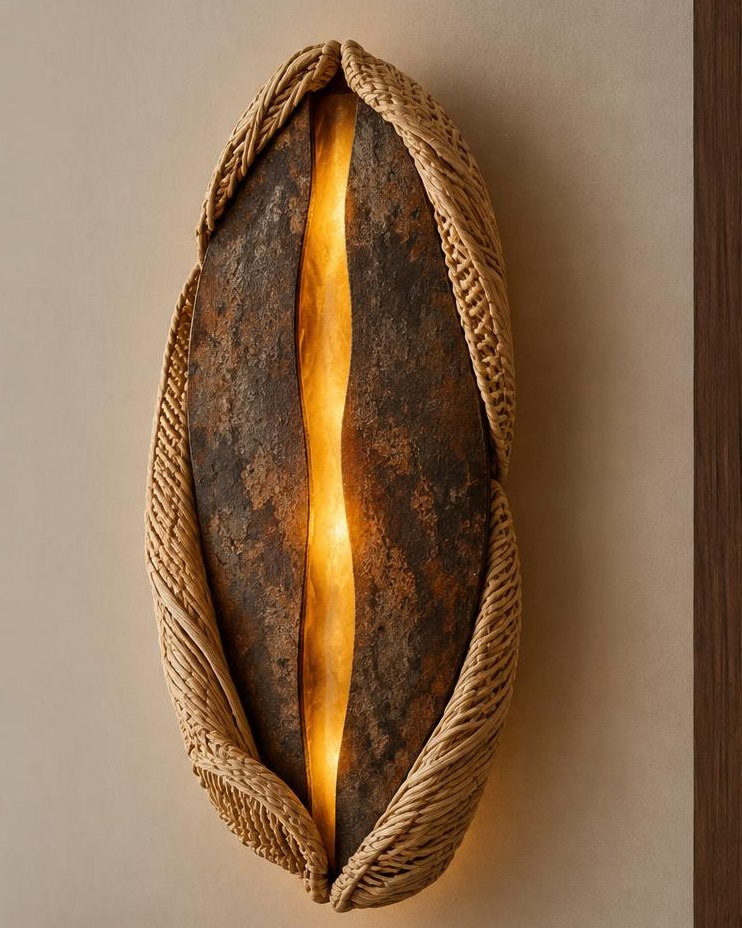
slit, fissure
10 · 20 · 30 cm
Wall light: a plate of oxidised metal with a slit of light, framed in raffia.
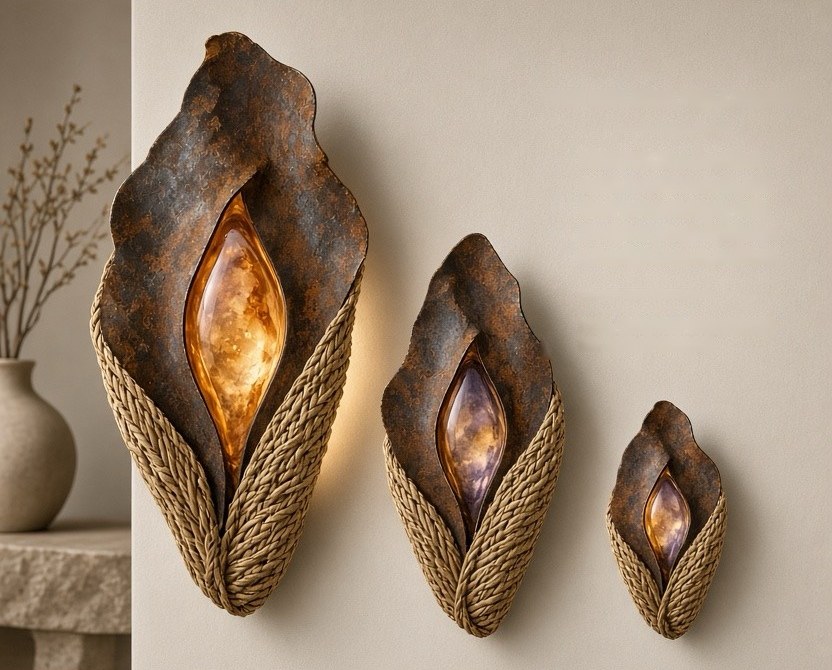
leaf
10 · 20 · 30 cm
Leaf-shaped wall light: oxidised metal, an eye of amber or violet resin, raffia woven in a wheat-ear braid.
The large pieces · 40–150 cm
When the eye rises: lamp-sculptures and floor columns, unique pieces for salons, lobbies and galleries.
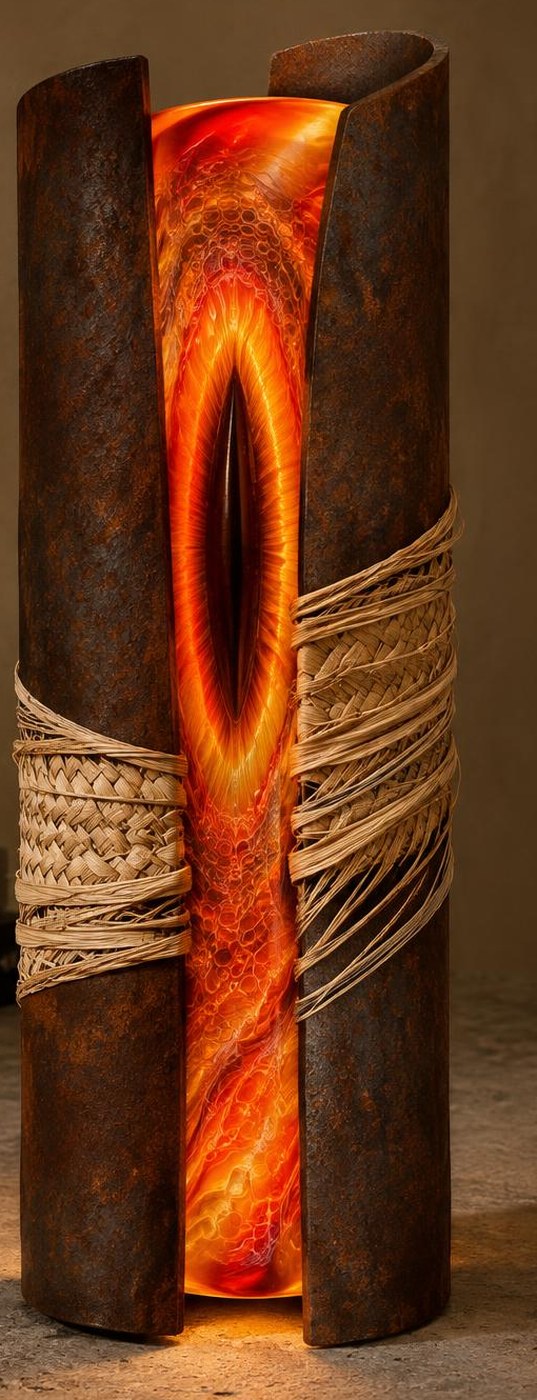
Argus, the hundred-eyed giant
40–60 cm
Lamp-sculpture: the oxidised metal opens onto an eye of glowing resin, swathed in raffia.
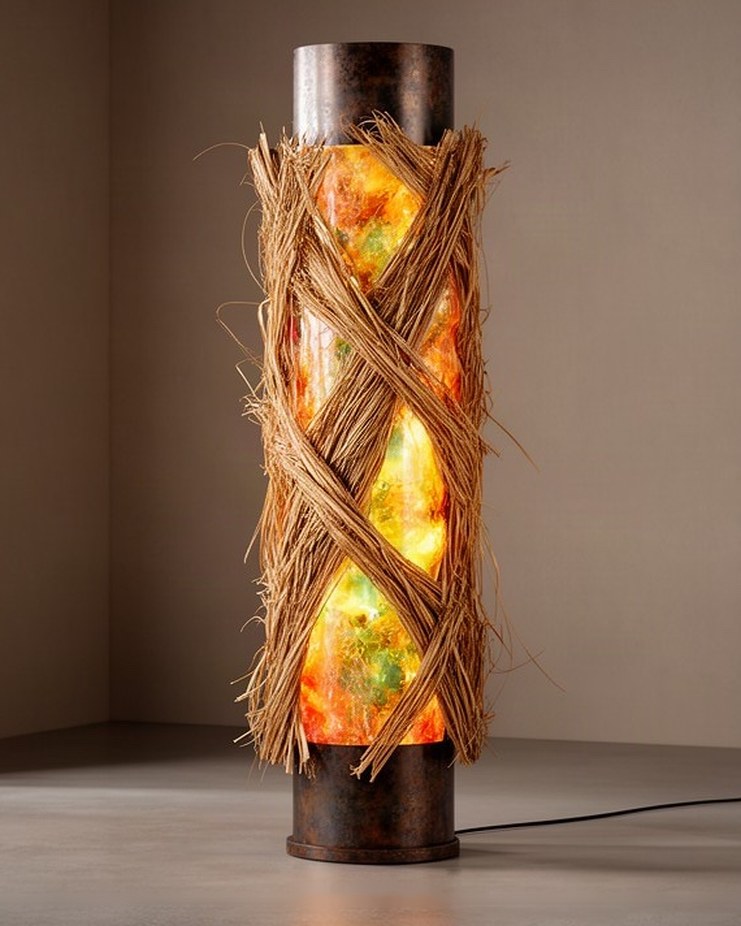
column
120–150 cm
Floor column: a tube of oxidised metal opening onto a fiery resin, wrapped in loose raffia braids.
The compositions
Several pieces in conversation: the triptych, the wall constellation, the Vogay pods, all the way to the installation.
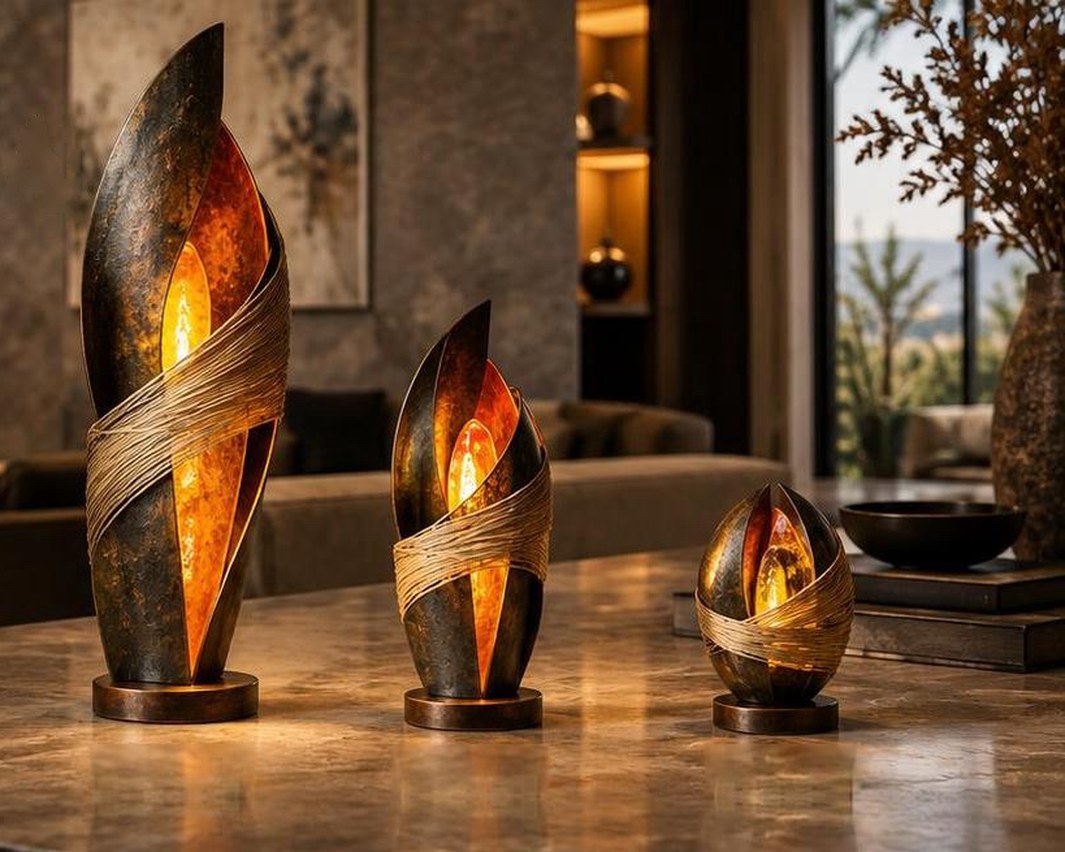
triptych
10 + 20 + 30 cm
The three sizes of the same form, numbered in sequence: the complete family.
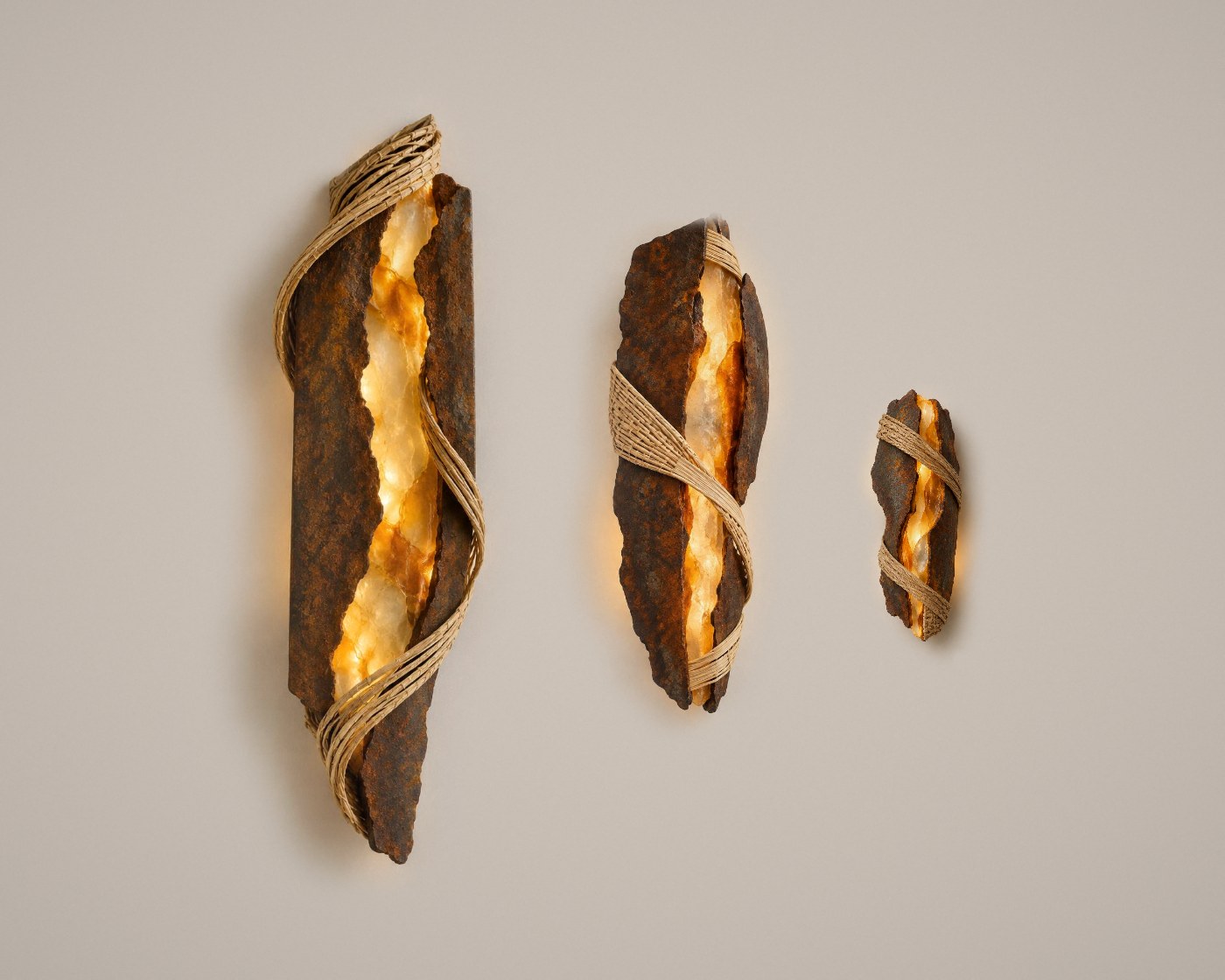
constellation
5–9 wall lights
A composition of RIMA and FOLIUM wall lights designed for your wall, with a hanging plan.
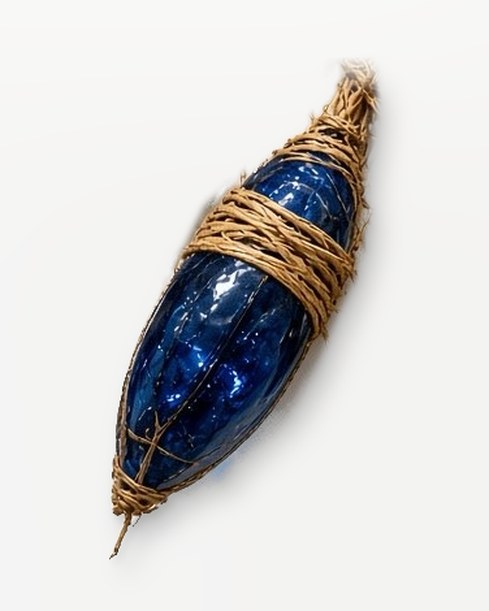
pod
25–90 cm
The Vogay pod: blue, amber or smoke resin enclosed in a raffia net, to be hung on its own.
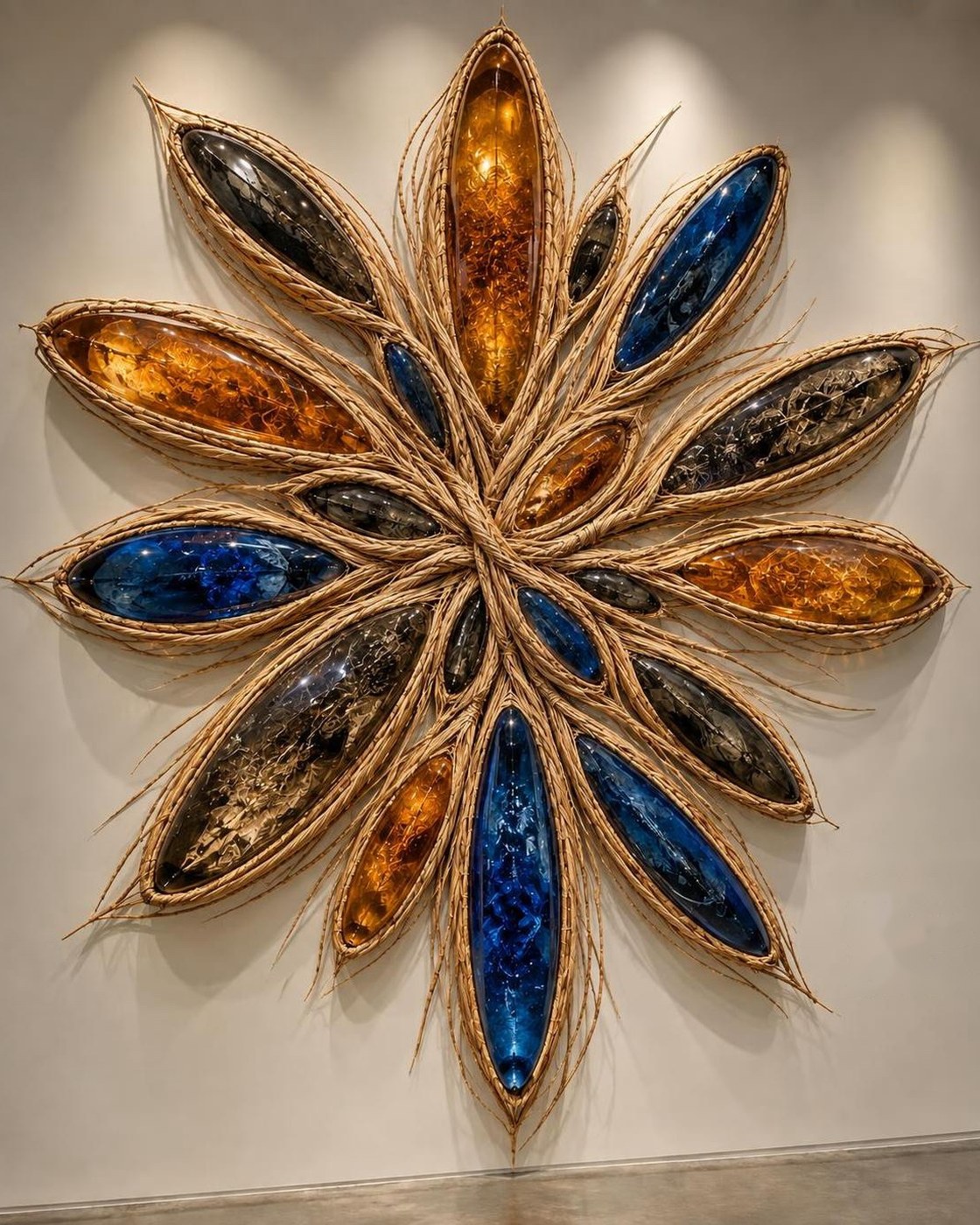
the installation
Ø 2.4 m
The complete sunburst of resin pods bound by raffia: a unique, signed work.
Who the campaign is for
From the small 10 cm piece to the triptych, from the ARGUS lamp to the installation: the first 100 enjoy a reserved price.
OFFICINA kits with raffia, resin, moulds and a video course; SCHOLA days at the Milan atelier.
MERCATOR lots for concept stores and HOSPES lots for hotels, with displays and renderings of the setting.
Your name on the founders’ wall of the future atelier in Madagascar.
Design images: photographs of the actual pieces will follow with the prototypes. Every object is handmade, numbered and certified; dates and contents may change until launch.
Catalogue
121 pages, every series, each piece with its story.
Scarica il catalogo (italiano)Télécharger le catalogue (français)
Notes
Every OCULI sculpture and lamp is a unique piece. The raffia is woven by hand and the resin is cast by hand: two examples of the same model will never be perfectly alike — the weave, the veining and the position of the pupil all change. Each piece is numbered, signed and accompanied by a certificate of authenticity issued by the artist Jan Ruju, attesting its model, number, materials and date of making. The small differences are not defects: they are proof that the piece exists only once.
Dimensions are approximate and may vary by a few centimetres from one piece to another.
Partly bio-based casting epoxy resin (over 50% carbon of plant origin), UV-stabilised, pigmented in the mass. The amber lenses are translucent; the spheres of the RUBRA series are cast solid and opaque.
The inclusions of the RIFLESSA series are reclaimed glass (bottles, panes, glassworks offcuts) selected by colour, broken and washed by hand, and cast into the resin without melting. No fragment is made on purpose. Edges and outer surfaces are smoothed and sealed within the resin.
The pieces of series II, VI, VII, VIII, IX and X are fitted with a low-voltage LED source, warm 2700 K light, dimmable. Power supply included. Lit versions are also available on request for the wall models of series I.
The lamps are CE marked (Low Voltage Directive 2014/35/EU, EN 60598). The LED source is kept at a distance from the fibre; the raffia is never in contact with hot parts.
Raffia harvested in Madagascar and woven in the Nosy Be showroom & atelier, with traceability. Assembly, resin, wiring and certification in Milan, Italy.
No editions: every piece is unique, numbered consecutively in the atelier register, signed and accompanied by a certificate of authenticity from the artist Jan Ruju.
Dust with a soft brush. Keep away from direct sunlight and humidity. The resin can be polished with a microfibre cloth.
OCULI, Raphia & Résine, Ambra Aliena, Rubra, Nexus, Spira, Riflessa, Vitrea, SpazioAlieno.Art and the names of all the pieces are registered trademarks. The works, drawings, texts and images in this catalogue are protected by copyright. Any reproduction, imitation or unauthorised use is prohibited.
Raffia structure: Raphia & Résine showroom & atelier, Nosy Be, Madagascar. Resin lens, bases, wiring and finishing: SpazioAlieno.Art showroom & atelier, Milan, Italy. Design: Jan Ruju, Milanese of Sardinian origin (Lula, Nuoro).
Availability, price, lens tint, lead time.